Black Friday 2026 PPC strategy: the first peak under Google's new controls
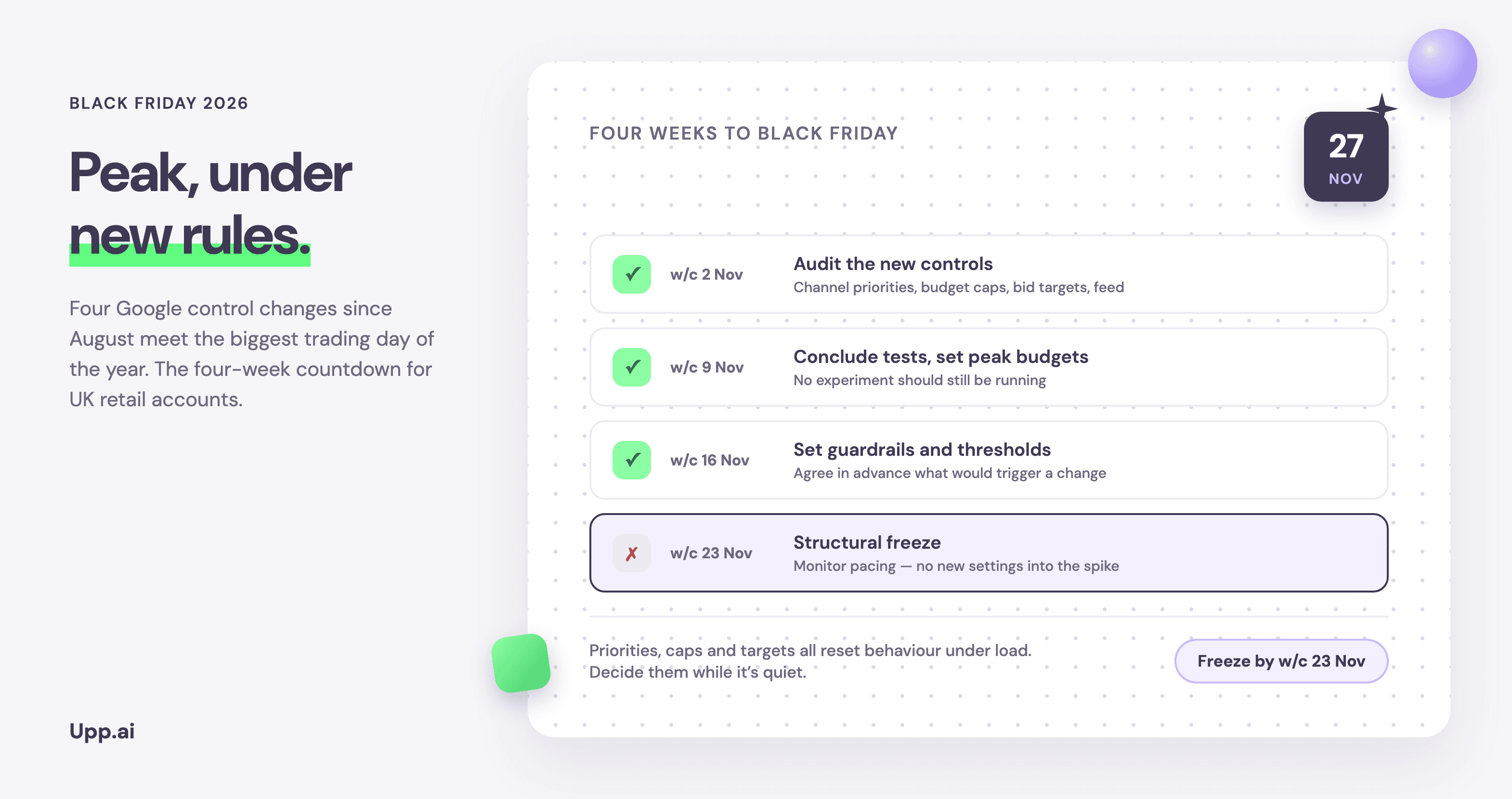
Black Friday lands on 27 November — the first peak since Google shipped four major control changes. The four-week countdown for UK retail accounts: what to audit, what to set, and what to freeze.
Black Friday 2026 · Black Friday in
Black Friday 2026 arrives on Friday 27 November, with Cyber Monday on the 30th. Last year UK shoppers spent £1.16 billion online on Black Friday alone — the single biggest online shopping day of the year — and £3.8 billion across the four-day weekend. The peak playbook is familiar territory for every retail PPC team. This year, the ground it stands on is not.
Since August, Google has shipped four significant control changes: the 17 August bidding change that altered how budget-limited campaigns treat your targets, the September AI Max migration that expanded how queries match, channel prioritisation and budget allocation announced on 14 October — which Google explicitly pitched at holiday trading — and the new experiment stack, including self-serve Conversion Lift. No UK retail account has traded a peak with any of these live, let alone all four at once.
This guide is the four-week countdown: what changed and why it matters more under load, what to audit and when, what you can still safely adjust during the spike, the AI shopping wildcard nobody planned for in 2024, and how to judge the results without fooling yourself.
Why peak 2026 is different
Each of the four changes is individually sensible. What makes this peak different is that they interact — and three of them only show their behaviour when campaigns come under budget pressure, which is precisely what Black Friday does to an account.
- The August bidding change: budget-limited tCPA and tROAS campaigns now deliver the target you set instead of opportunistically beating it. During peak, when campaigns hit their budgets daily, this means the target you carry into Black Friday week is the target you get — volume comes from budget headroom, not from the system stretching.
- The AI Max migration: September's auto-upgrade expanded matching on Search campaigns. This is the first peak where query volume spikes meet the broader matching behaviour — worth watching search term reports more closely than usual in the first week of November.
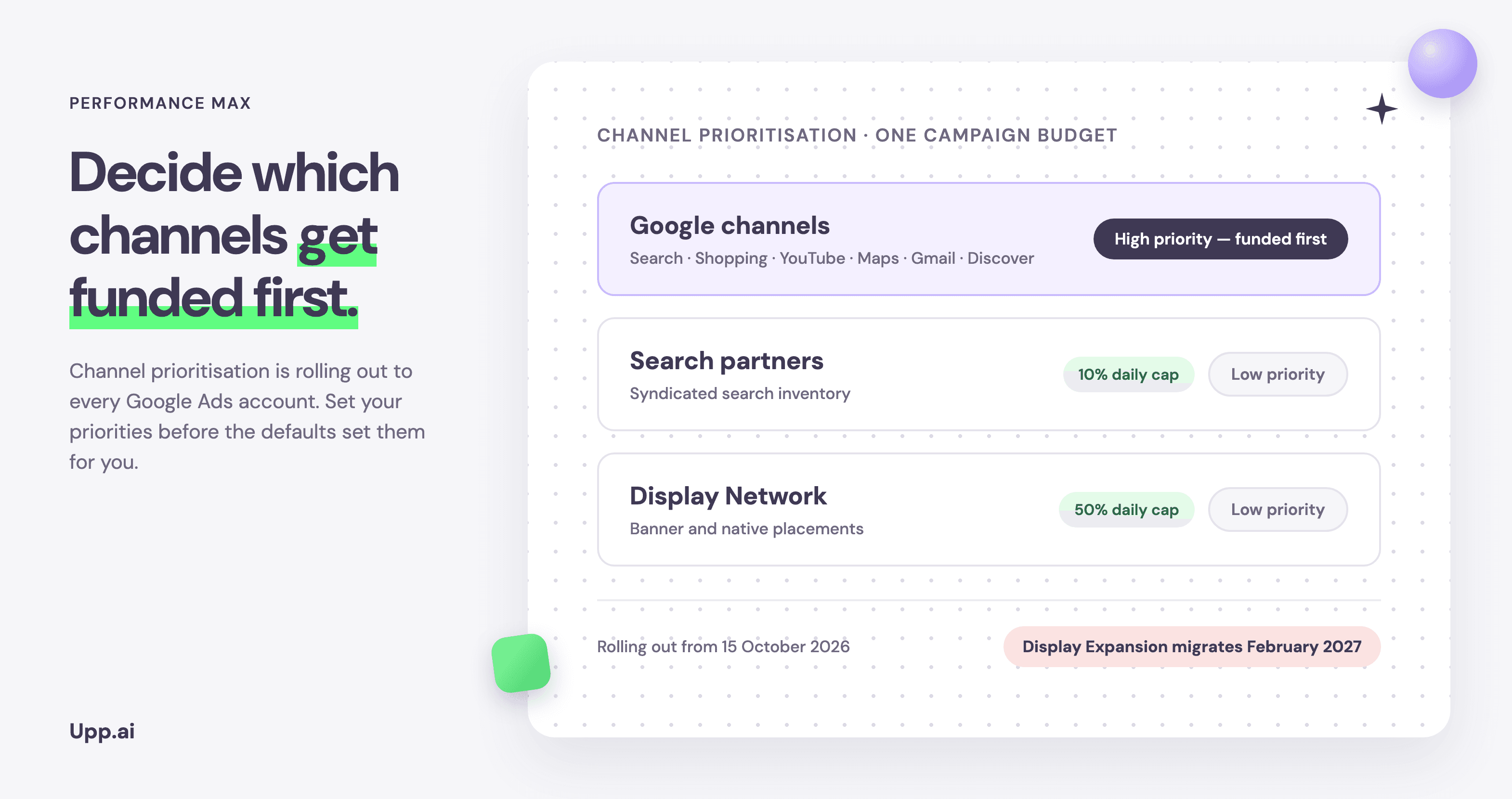
- Channel prioritisation: priority levels only change spend when a campaign is budget-limited. Most accounts aren't budget-limited in quiet weeks, so the priorities set in October have been dormant. Black Friday week is when they activate — and every channel defaults to High priority.
- The new experiment stack: PMax asset experiments and self-serve Conversion Lift arrived in October. The tools are welcome; the timing is a trap. A lift test needs four to six weeks of stable conditions, and November offers neither.
Add the seasonal pressure — Adobe counted 25 days last season when US consumers spent over $4 billion online in a single day — and the case for preparation over reaction makes itself. Here is the countdown.
The four-week countdown
Week of 2 November: audit the controls you've inherited
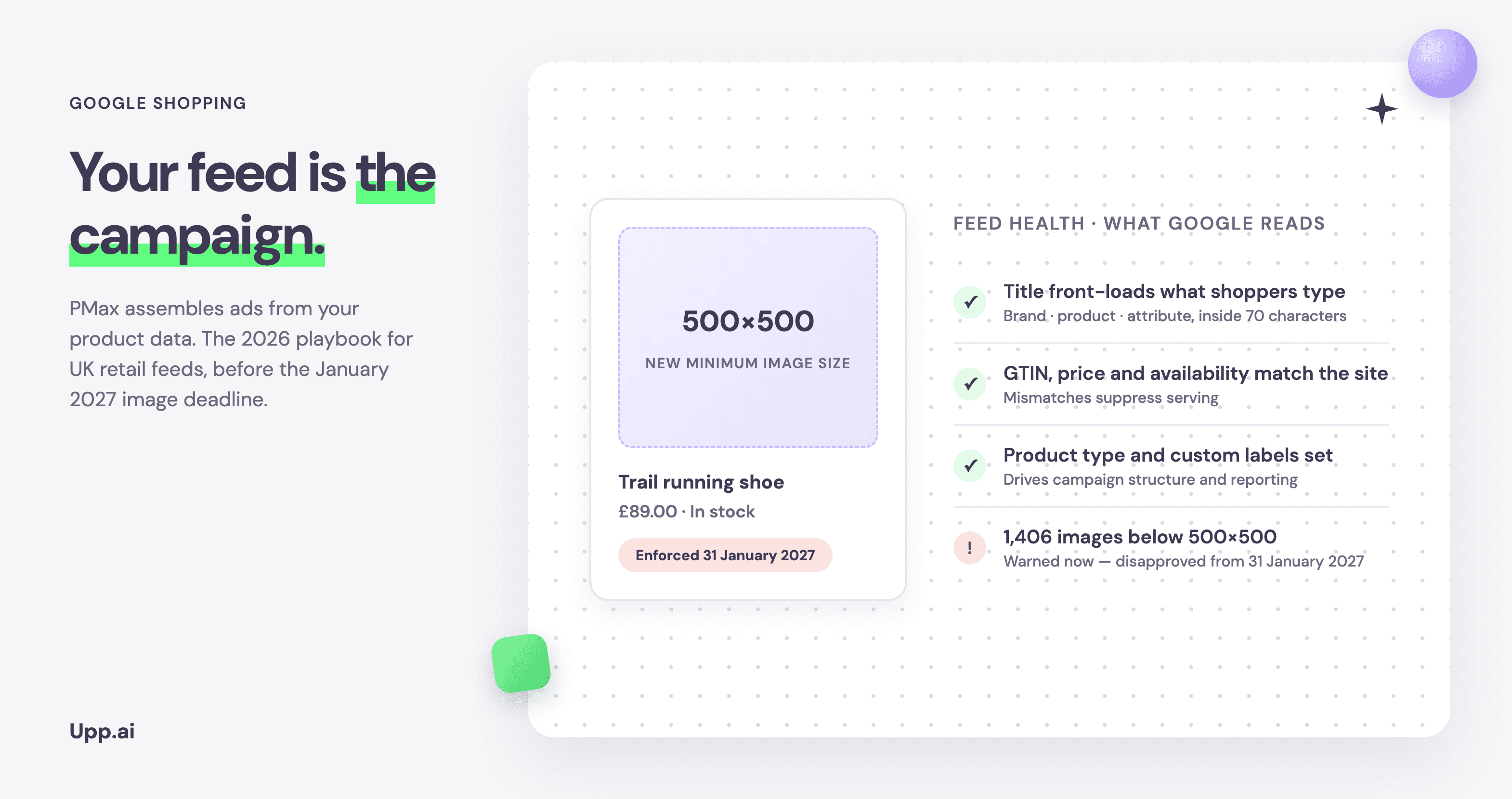
Start with what Google switched on for you. Pull channel priorities on every campaign — every channel starts High, including Search partners and Display inventory your account may have deliberately excluded for years. Check budget allocation caps, confirm bid targets still encode your intent after the August change, and run the feed checks that decide Shopping visibility: image quality, availability accuracy, sale price fields ready for promo windows.
Week of 9 November: conclude tests, set peak budgets
No experiment should still be running by mid-November — mid-flight changes contaminate the test and the test constrains the account. Set peak budgets with deliberate headroom: after the August change, budget is the volume lever, so decide now how much you're willing to deploy if Black Friday week runs hot, and pre-agree who signs it off.
Week of 16 November: set guardrails and exception thresholds
Write down, in advance, what would justify touching the account during peak: the pacing band that triggers a budget release, the ROAS floor that triggers a pullback, the out-of-stock rate that pauses a product group. A threshold agreed on the 16th is a decision; the same threshold invented at 11pm on the 27th is a guess.
Week of 23 November: structural freeze
From here, structure is frozen: no new campaigns, no bid strategy changes, no feed schema edits, nothing that re-enters learning. Promo assets should already be scheduled. What remains is cadence — pacing and pacing exceptions checked twice daily, with the thresholds you wrote last week deciding what counts as an exception.
Budgets and bidding during the spike
The question every team asks in Black Friday week is “should we intervene?” The honest answer under the new controls: less than you used to, and only where you planned to. The August change rewards accounts that plan budget headroom — a budget-limited tROAS campaign now holds your target rather than chasing volume beyond it, so raising budget inside a pre-agreed band is a controlled action, not a gamble. Seasonality adjustments remain the right tool for a known, short conversion-rate jump around the promo window itself — they are not a volume lever.
How retail search demand builds into Black Friday week
The AI shopping wildcard: Gemini, AI Mode and agents at the checkout
Last year was the first holiday season where AI product discovery stopped being hypothetical. Adobe measured a 693% year-on-year increase in traffic referred to US retail sites from generative AI tools across November and December — and that traffic converted 31% higher than other sources. On Black Friday itself, the conversion gap was 38%. These are US figures on a still-modest base, but the direction held into 2026, and conversion gaps like that don't come from idle browsing.
Google has spent the year wiring shopping into its AI surfaces. AI Mode — which Google says has passed a billion monthly users — and the Gemini app both draw product results from the Shopping Graph's 50-billion-plus listings. In the US, agentic checkout and Universal Cart already complete purchases without the shopper ever reaching the retailer's website. The UK is on the published rollout list with no date — a preview audience, not yet the battleground. But UK shoppers aren't waiting for the checkout: Barclays found 8% planned to use tools like Gemini and ChatGPT to source Black Friday deals last year, rising to 17% of Gen Z.
Two practical consequences for this peak. First, the same feed quality that drives Shopping performance now decides whether your products appear credibly in AI answers — one more reason the week-of-2-November feed audit matters. Second, it is worth knowing what AI engines currently say about your brand and products before your busiest trading window: our guide to AEO and GEO for paid media teams covers the mechanics, and a free AI visibility audit shows you your starting point. We'll publish a full analysis of agentic commerce — and what Google's Universal Commerce Protocol means for Shopping ads — next week.
Measuring peak without fooling yourself
Black Friday distorts every measurement system you own. Promo codes and brand searches pull last-click credit towards the bottom of the funnel; pulled-forward demand makes November look heroic and early December look broken; and platform-reported ROAS inflates exactly when CPCs do. The metrics that survive peak are the blended ones: MER against the full promo-period spend, and new-customer share — because a Black Friday that only re-converted your existing base at a discount is a margin event, not a growth event.
The cleanest answer — an incrementality test — is off the table for this peak: the windows are four to six weeks and the baseline is about to go vertical. So pre-agree now how Black Friday will be judged, capture clean data through the period, and book the January lift test while the diary is still empty. Media mix modelling can then put peak in context across the whole quarter.
The accounts that win Black Friday aren't the ones that react fastest. They're the ones that decided in advance what they would never touch.
Peak is a cadence problem, not a knowledge problem
Nothing in the countdown above is a secret. Every experienced retail team knows the checklist — the hard part has never been knowing it. The hard part is that Black Friday week moves hourly, the team is stretched across every channel at once, and the account now carries more live settings than ever: priorities, caps, targets, adjustments, experiments. Knowledge doesn't fail at peak. Cadence does.
Frequently asked questions
When should I start preparing Google Ads for Black Friday 2026?
The structured window opens four weeks out: audit the new controls in the week of 2 November, conclude tests and set budgets by the 13th, set guardrails by the 20th, and freeze structure from the week of 23 November. Feed fixes and experiment wind-downs take longer than teams expect — start those first.
Should I raise budgets during Black Friday week?
Yes, if you planned to. After the August bidding change, budget-limited tCPA and tROAS campaigns hold your target rather than stretching past it, so budget headroom is the main volume lever at peak. Decide the band and the sign-off in advance; a planned release inside a pre-agreed band is safe, an improvised doubling at midnight is not.
Should I change tROAS targets during the spike?
Only within bands you agreed before the week started, and prefer seasonality adjustments for short, known conversion-rate jumps around the promo window. Large target swings during peak force the bidding system to relearn in the most volatile week of the year.
Can I run experiments during Black Friday?
No — conclude them first. PMax asset experiments and Conversion Lift tests need four to six weeks of reasonably stable conditions to read cleanly, and peak is the least stable trading of the year. January, with its stable baseline and quieter diary, is the natural testing window.
How do I measure whether Black Friday actually worked?
Pre-agree the judging metrics before peak: blended MER across the full promo period, new-customer share, and margin after discounts — not platform-reported ROAS, which inflates during promos. Then validate with an incrementality test in January and let media mix modelling put the quarter in context.
Sources: Adobe Digital Insights UK holiday data, Adobe's 2025 holiday season report and Adobe Analytics AI traffic analysis (January 2026); Barclays Consumer Spend Report (November 2025); Google's channel prioritisation announcement (October 2026). The demand curve is illustrative.
Move your paid media to AI
Peak moves hourly. Set the strategy in the quiet weeks and let Rubin hold it through the spike — budgets, bids and pacing inside your guardrails.
Keep reading
Performance Max channel prioritisation: the complete UK ecommerce guide
Google is rolling out channel prioritisation and budget allocation controls from 15 October. What UK retail teams can set inside PMax, what they still can't, and the February 2027 date to diary.
Upp.ai insights team
Google Shopping feed optimisation: the 2026 playbook for UK retail brands
PMax assembles your ads from your product data, so the feed decides which auctions you enter. A practical playbook for UK retail — and the 31 January 2027 image deadline to beat.
Upp.ai insights team
Incrementality testing for retail PPC: how to prove true ROAS
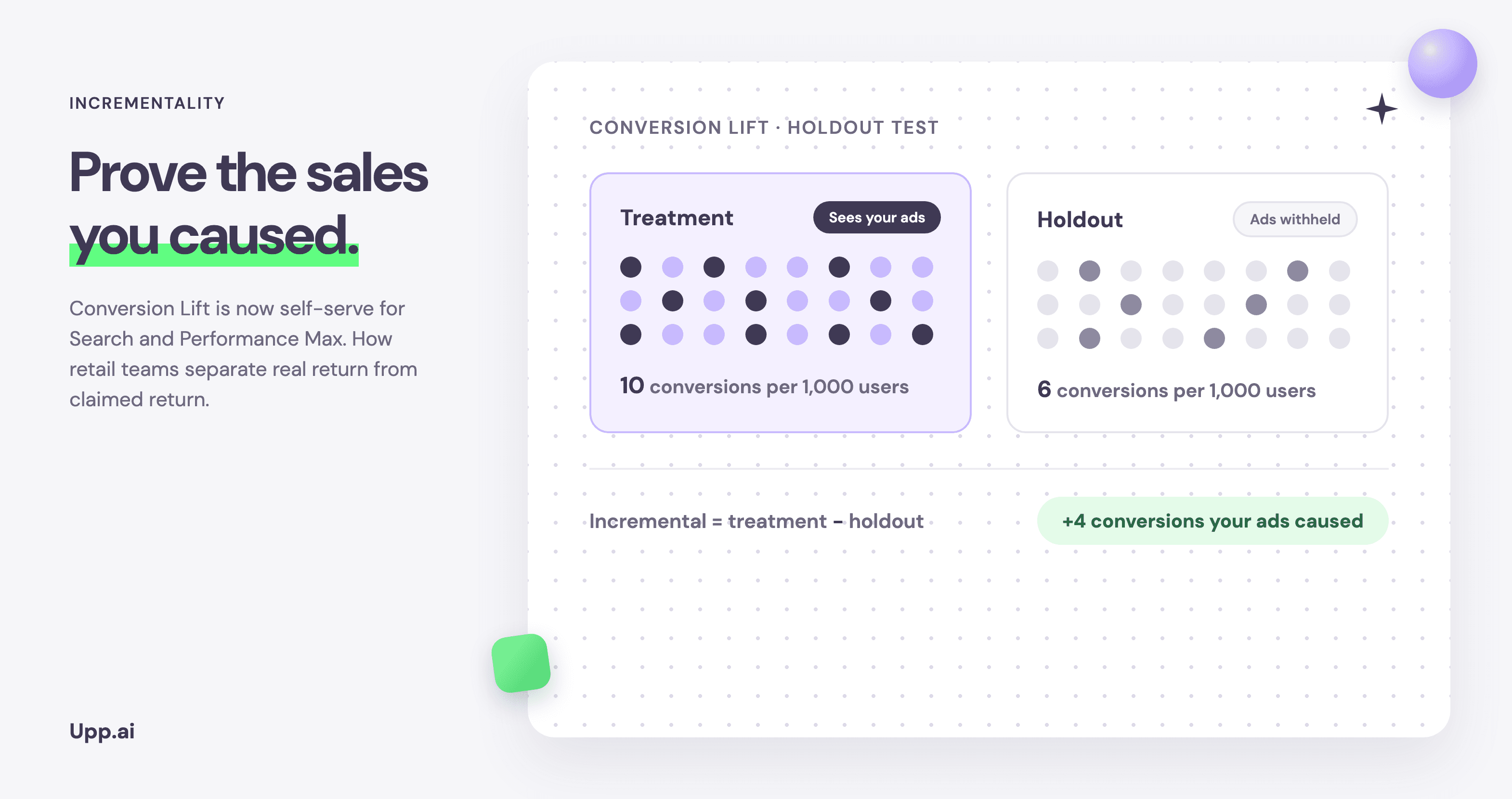
Google has made Conversion Lift self-serve for Search and Performance Max. How to run holdout tests that separate the sales your ads caused from the sales you'd have made anyway.
Upp.ai insights team