Incrementality testing for retail PPC: how to prove true ROAS
Google has made Conversion Lift self-serve for Search and Performance Max. How to run holdout tests that separate the sales your ads caused from the sales you'd have made anyway.
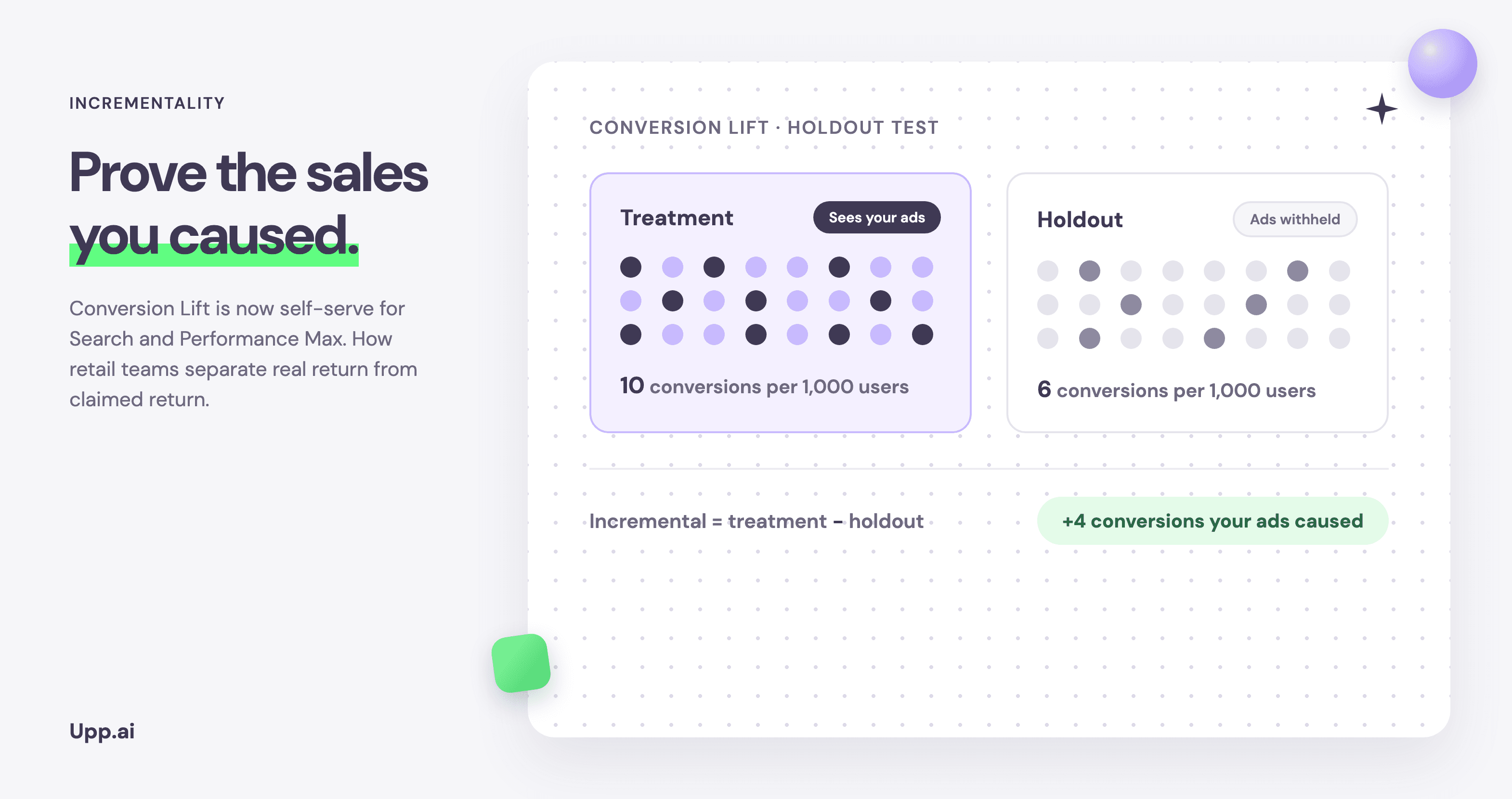
Earlier this year we made the case that incrementality has replaced ROAS as the measure that matters: finance is no longer asking what the platform attributed, it's asking what the spend caused. That post covered why. This one covers how — because in October, Google removed the biggest practical barrier for retail teams.
User-based Conversion Lift — Google's holdout-testing product — is now available for self-serve setup on Search and Performance Max campaigns, the two formats where UK retail budgets actually sit. Until now, those campaign types needed a Google representative to arrange a study. For mid-market retailers without a dedicated account team, that was the difference between “we should test incrementality” and actually doing it.
What incrementality testing actually measures
The design is old science applied to ad spend: a randomised controlled experiment. Eligible users split into two groups. The treatment group is exposed to your campaigns as normal. The holdout group has your ads withheld. Both groups keep shopping, searching and converting — the only systematic difference between them is the advertising.
Incremental conversions are the difference: treatment conversions minus holdout conversions. Divide the incremental conversion value by the spend and you have incremental ROAS — the return on sales that would not have happened without the ads. Crucially, lift measurement deliberately ignores your attribution settings. No click windows, no credit rules. Just the difference between two otherwise-identical populations.
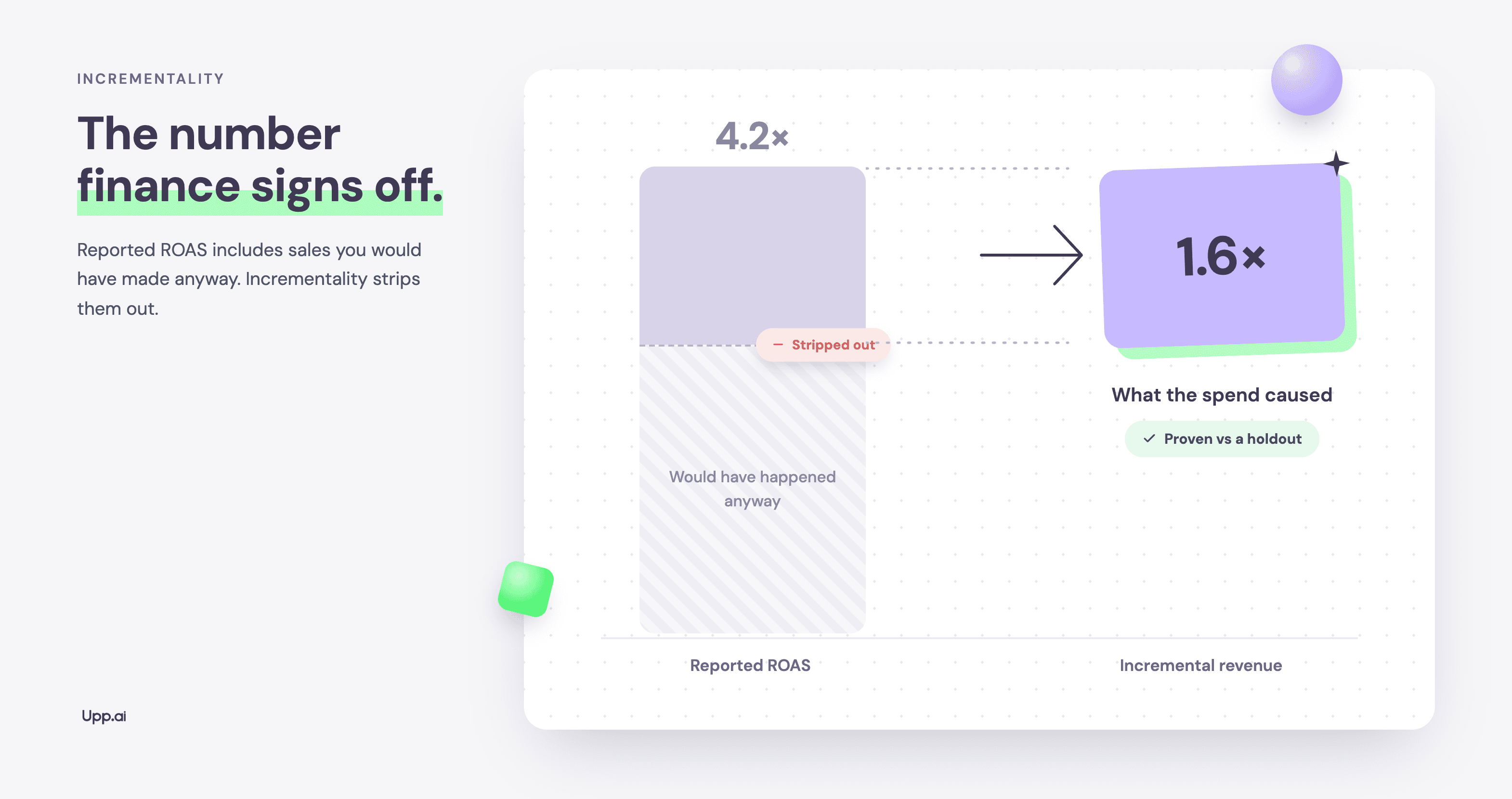
That's why reported ROAS and incremental ROAS diverge, sometimes dramatically. Reported ROAS includes every sale the ads touched — including loyal customers who searched your brand name and would have bought regardless. For retail accounts with strong brand demand, that gap is usually widest exactly where spend feels safest.
Reported vs incremental: the gap that matters
Running a self-serve Conversion Lift study
1. Check you clear the thresholds
Google's eligibility requirements are at least 1,000 observed conversions (conversions modelled from supplementary data don't count), a minimum $5,000 campaign budget for the study, and at least one compatible conversion action. A campaign can only sit in one lift study at a time — Brand, Search or Conversion Lift — so unwind any existing study first.
2. Design around a decision
Write the decision down before the test starts: “If incremental ROAS on generic PMax is below 1.5, we cut its budget 20% and move it to prospecting.” Pre-registering the threshold keeps the result from being re-interpreted to fit whatever everyone already believed — the most common way lift tests get wasted.
3. Choose the holdback deliberately
The holdback — 1% to 50% of eligible users — sets the test's trade-off. A larger holdout reaches statistical confidence faster but withholds ads from more potential buyers while it runs. Google's feasibility tool estimates study power before you commit; treat the recommended 90%+ as a floor, and let the tool tell you whether your conversion volume can support a small holdback.
4. Run it clean
Lift studies measure the campaigns as they ran. Major mid-test changes — budget swings, new asset groups, promotional pricing that only one group experiences through other channels — muddy the read. Plan at least two weeks, longer for considered purchases, and if Q4 promotions are non-negotiable, note them and judge the result accordingly.
5. Read the result as a range, not a verdict
The output is an estimate with a confidence interval: absolute lift, relative lift, and cost per incremental conversion. A wide interval straddling zero isn't a failed test — it's information that this campaign, at this volume, can't be distinguished from background noise. That is itself a budget-relevant finding.
Where platform lift tests fall short
A self-serve holdout from Google is a genuine step forward, and materially better than attribution alone. It is still Google measuring Google. That isn't an accusation of bad faith — it's a structural limit on what the test can see.
The practical posture for a retail team: use self-serve Conversion Lift to pressure-test your biggest Google line items, use geo-based holdouts where user-based studies can't reach, and calibrate the whole picture with media mix modelling and independent measurement. We covered how these numbers should land in the boardroom in our PPC reporting guide.
Reported ROAS includes every sale the ads touched. Incremental ROAS counts the sales that wouldn't exist without them. Budgets built on the first number fund the past; budgets built on the second fund growth.
From test result to budget decision
A lift test earns its cost when the result moves money. The pattern that works: test the two or three largest budget lines a quarter, pre-agree the reallocation rule, execute it, and re-test next quarter — because incrementality is not a property of a channel, it's a property of a channel at a spend level in a market condition. Brand search might be barely incremental in October and strongly incremental in January when competitors pile in.
This is also where one-off testing shows its limits as an operating model. A quarterly test gives you a quarterly answer, and the market doesn't wait for it. When B&Q rebuilt their paid media around continuously proven incremental return with Upp.ai, the result over twelve months was a 16% ROAS improvement and 40% more product visibility on the same budget — not from one heroic test, but from measurement running at the same cadence as the decisions.
Frequently asked questions
What is incrementality testing in PPC?
A controlled experiment that measures the sales your ads caused. Users (or regions) are split into a treatment group that sees ads and a holdout group that doesn't; the difference in conversions between the groups is the incremental impact — the sales that would not have happened without the spend.
What is Google's Conversion Lift, and who can use it now?
Conversion Lift based on users is Google's built-in holdout test. As of October 2026 it supports self-serve setup for Search and Performance Max (alongside Display, Video, Demand Gen and App campaigns) for accounts with at least 1,000 observed conversions, a $5,000 minimum campaign budget and a compatible conversion action. Find it under Experiments in Google Ads.
What's the difference between ROAS and incremental ROAS?
ROAS divides attributed revenue by spend, and attributed revenue includes sales that would have happened anyway. Incremental ROAS divides holdout-proven incremental revenue by spend. The second is almost always lower — and it's the number that tells you whether the spend created value.
How long should an incrementality test run?
Google recommends at least two weeks, and longer where conversion cycles are slow. The honest answer is: until your feasibility estimate says the study has enough power to detect the lift you care about — which depends on conversion volume and holdback size, not the calendar.
Do I still need incrementality testing if I have attribution?
Yes. Attribution assigns credit among touchpoints for conversions that happened; it cannot see the counterfactual. Only a holdout answers what would have happened without the ad — which is the question budget decisions actually depend on.
Sources: Google Ads Help, set up Conversion Lift based on users; Search Engine Land coverage of the Search and PMax expansion, October 2026; Upp.ai x B&Q case study. Worked figures are illustrative.
Move your paid media to AI
Turn lift tests into budget decisions your CFO signs off. See how Rubin Measure proves incremental return continuously.
Keep reading
Why incrementality has replaced ROAS as the measure that matters
Finance is now asking a different question, and incrementality is the only lens that answers it.
Upp.ai insights team
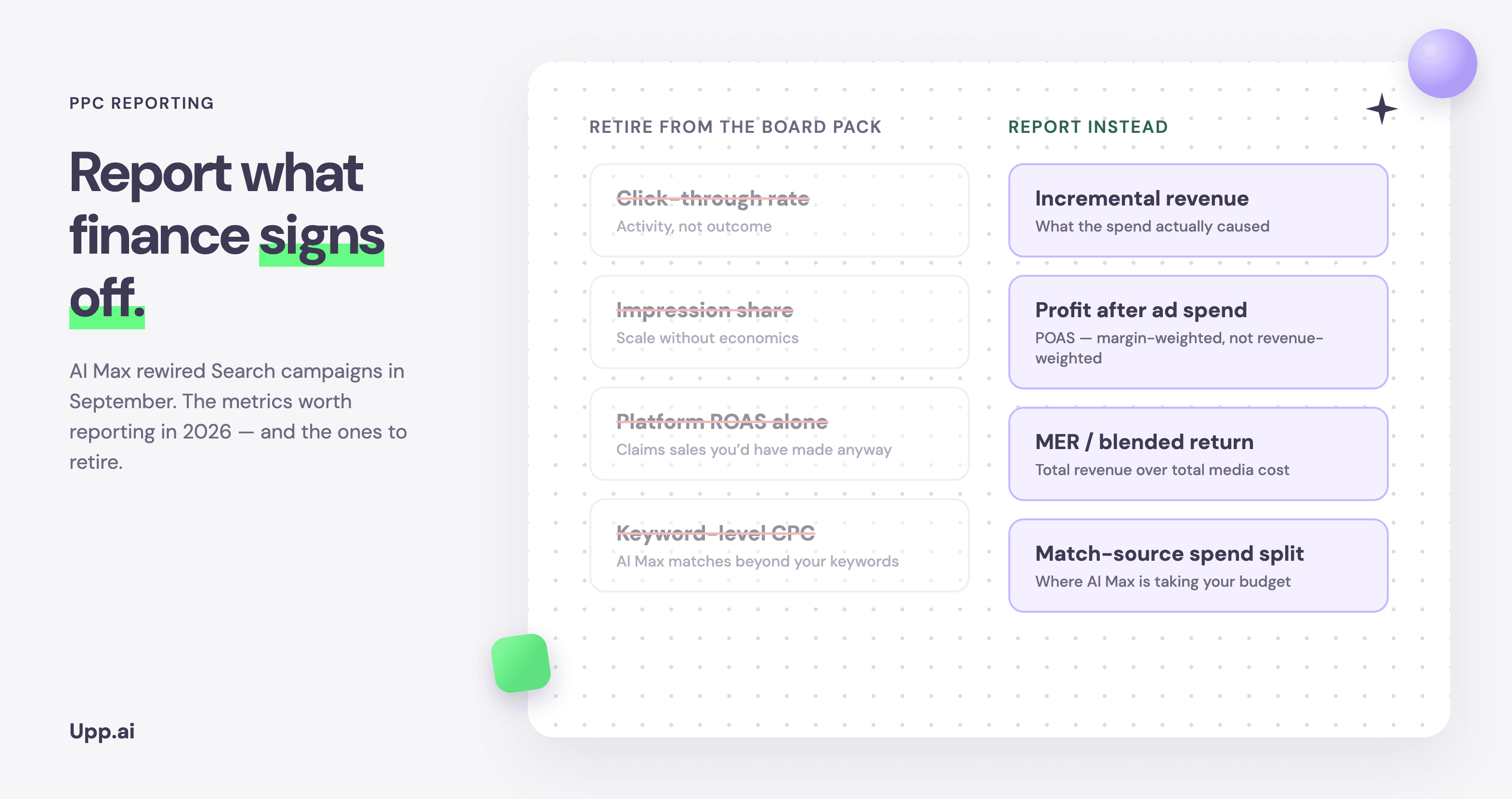
PPC reporting in 2026: what metrics actually matter after the AI Max migration
September's AI Max migration quietly rewired how Search campaigns match and report. The metrics worth presenting now, the ones to retire from the board pack, and how to reconcile the change.
Upp.ai insights team
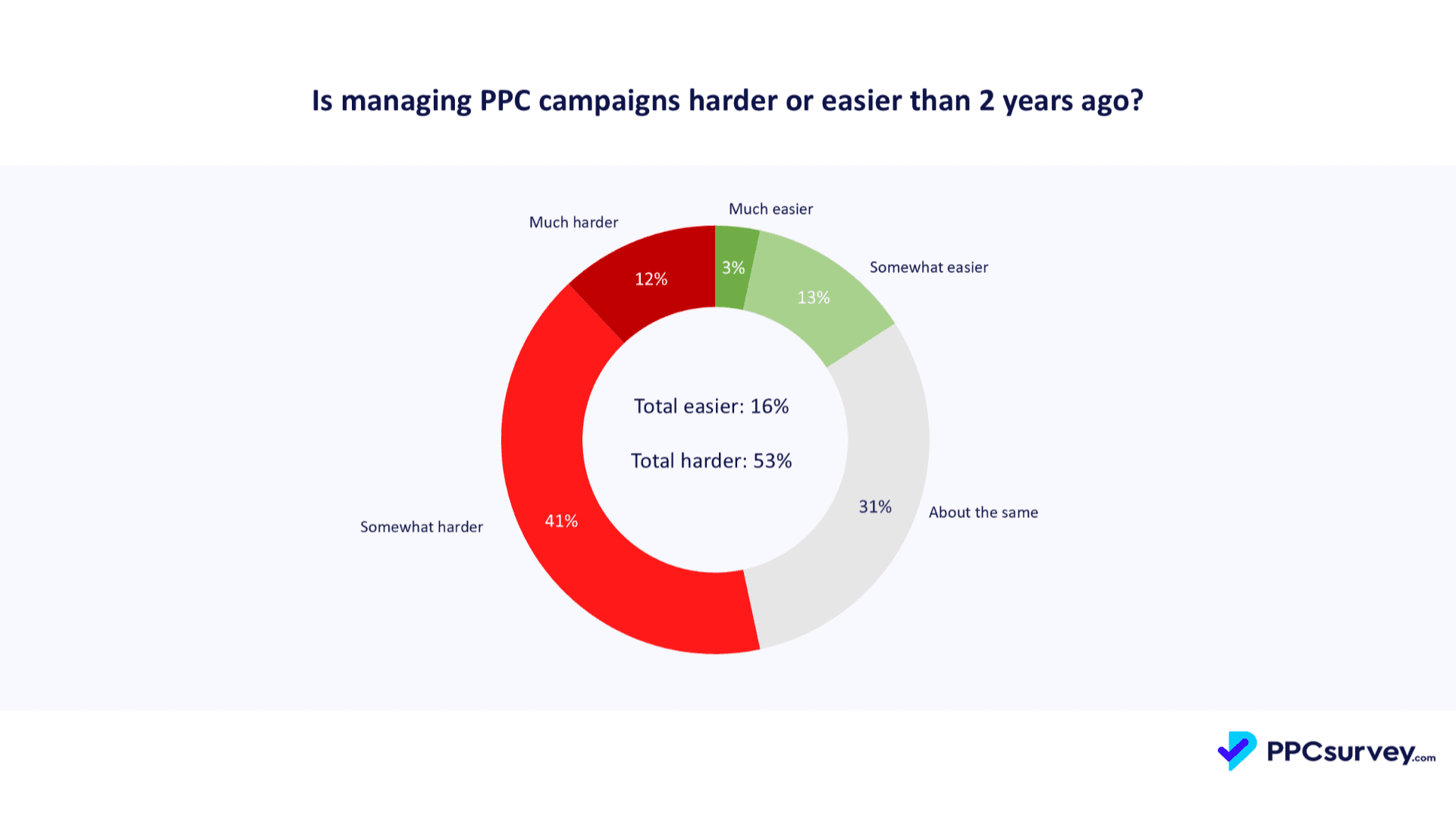
The State of PPC 2026: control is now the scarcest resource in paid media
Global ad spend crossed $1 trillion in 2025. The 1,306 professionals behind the industry's largest survey say the work has never been harder to control, or to prove. Here is what the data actually says, and what the strongest teams are doing about it.
Upp.ai insights team