Agentic commerce: what agentic checkout, Universal Cart and UCP mean for Google Shopping
Google's agentic checkout and Universal Cart let shoppers buy without ever reaching your website. How the Universal Commerce Protocol works, what it does to Shopping ads and measurement, and the UK to-do list.
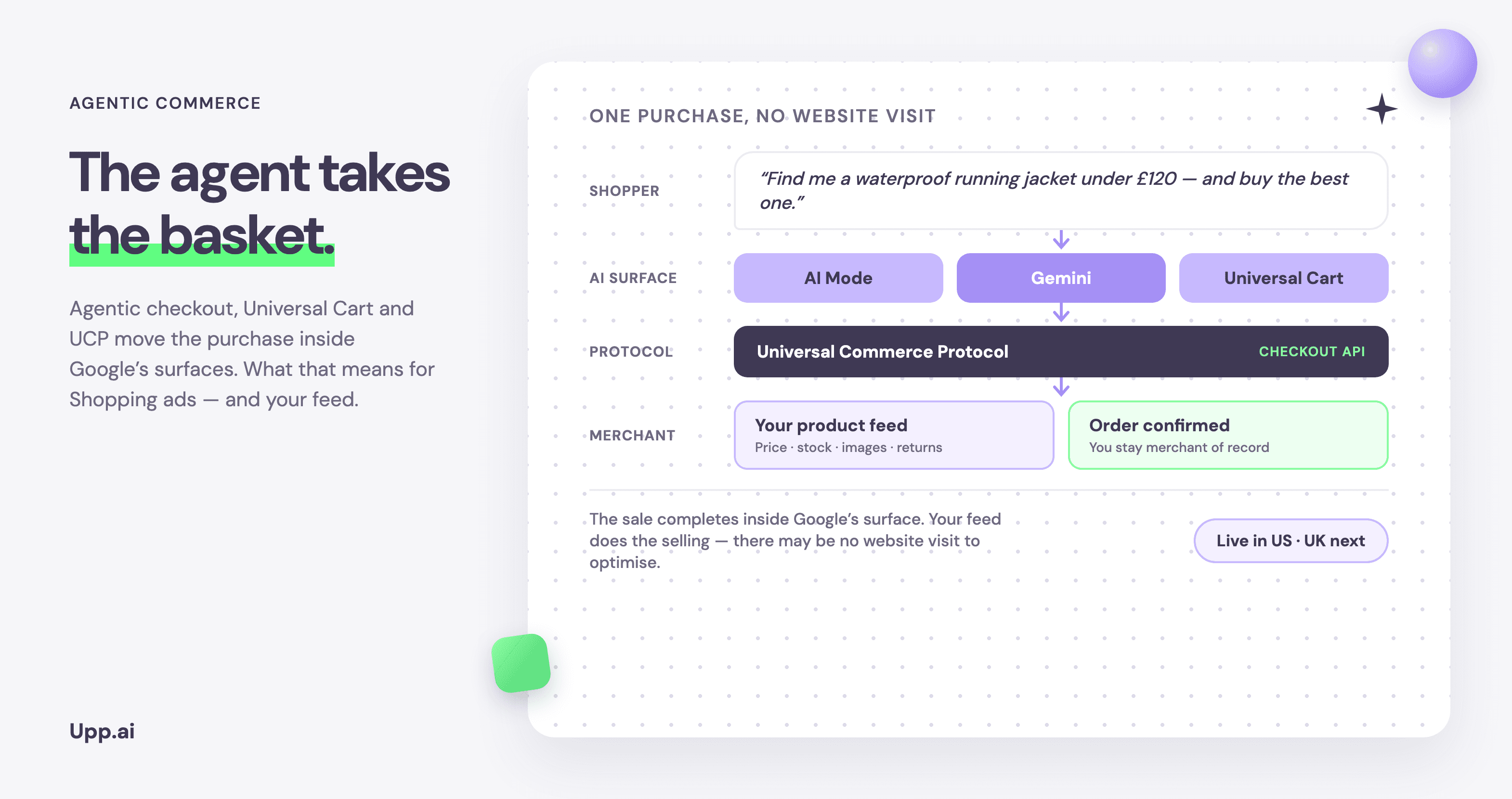
In November 2025, Google announced agentic checkout — an agent that buys on the shopper's behalf. In January 2026 it launched the Universal Commerce Protocol, an open standard co-developed with Shopify, Etsy, Wayfair, Target and Walmart. At I/O in May came Universal Cart, a cross-retailer basket that works across Search and the Gemini app. By this autumn, shoppers in the US could tap Buy on listings from Nike, Sephora, Target, Ulta Beauty, Walmart and Wayfair — and pay with Google Pay without ever leaving the conversation.
For retail PPC teams, the significance is structural. For twenty years, a Shopping sale had the same shape: the ad won the click, your website did the convincing, your checkout closed the sale. Agentic commerce removes the middle of that journey. The feed becomes the storefront, the protocol becomes the checkout, and the website — the thing your conversion rate optimisation budget has spent a decade polishing — may never be visited at all.
This guide covers how agentic checkout actually works, what it changes about the Shopping ads model, what happens to measurement when an agent buys, the protocol race beyond Google, and what UK retailers should do while the Buy button is still a US story.
How agentic checkout actually works
Two things travel under the “agentic commerce” banner and they are worth separating. Agentic checkout is Google's agent buying on the customer's behalf — at their direction — directly on a merchant's website. The Universal Commerce Protocol is the open standard underneath: a common language that lets agents and merchant systems exchange checkout information programmatically, via API, MCP or Agent2Agent. UCP is what powers the Buy button on eligible product listings in AI Mode and Gemini.
The shopper's experience is the point. They describe what they want, AI Mode or Gemini assembles a comparison from the Shopping Graph, and when they're ready, checkout happens inside the Google Pay flow using payment and delivery details already saved in their Google account — or they transfer their Universal Cart to the merchant's site in one tap to finish there. Either way, Google is explicit on one principle: the retailer remains the merchant of record. You keep the customer, the payment relationship, the returns and the support.
Participation is gated. Checkout is live for selected merchants on eligible US products, with eligibility extending to Canada and Australia; only listings carrying the checkout-eligibility product attribute show the Buy button, and everyone else joins via an early-access interest form. Google's Marketing Live announcements point at where it goes next: UCP-powered checkout in Shopping ads on YouTube, plus whole new verticals — hotel booking in AI Mode, food delivery from a conversation in Maps.
What it does to the Shopping ads model
Shopping ads have always been a rental agreement: you pay for the click, your site does the converting. Agent-completed checkout collapses those two jobs into one data layer. The feed attributes that used to be quality signals — price accuracy, stock status, image standards, returns policy — become the material the transaction is built from. A price that drifts out of sync with your site used to risk a disapproval; in an agentic flow it produces a failed or mispriced order in front of a customer who delegated their trust to the agent.
The auction doesn't disappear — discovery is still where Shopping ads earn their keep, and UCP checkout is coming to the ads themselves, starting with YouTube. What changes is what wins. An agent assembling a comparison table has no patience for aspirational data: it cross-checks price, availability and delivery promises, and quietly drops the listings that don't hold up. The feed optimisation playbook stops being a Shopping tactic and becomes the whole game — the same attributes now decide auction eligibility, AI-surface visibility and checkout integrity simultaneously.
AI-referred traffic to US retail sites, growth year on year
What happens to measurement when an agent buys
An order completed inside AI Mode never touches your website. There is no session for analytics to record, no pixel fire on a thank-you page you control, and no click path for last-click attribution to misread — because there is no path at all. The order still lands in your systems, because you are the merchant of record. The journey data stays on the surface where the journey happened.
This accelerates a shift that was already overdue. If your reporting leans on platform-attributed conversions, agentic orders will look like organic windfalls or vanish into direct; the metrics that still mean something are blended ones, and the honest way to credit a channel is an incrementality test, not a click trail. At the planning level, media mix modelling can absorb a channel whose purchases happen off-site — last-click attribution cannot.
Three practical moves now: get conversion tracking server-side so an order placed on Google is captured at the order-management layer rather than the browser; reconcile Merchant Center order reporting against platform-attributed conversions so the gap is measured instead of guessed; and tag agent-originated orders in your OMS from day one, so when finance asks what agentic commerce is worth, the answer is a number.
The protocol race beyond Google
Google is not running alone, and the competing efforts are converging on the same lesson. OpenAI and Stripe launched Instant Checkout in ChatGPT in September 2025 — then retired its first version in March 2026, saying it “did not offer the level of flexibility that we aspire to provide.” The Agentic Commerce Protocol now carries product feeds, discovery and promotions into ChatGPT while merchants keep their own checkout, with Target, Sephora, Nordstrom, Lowe's, Best Buy, The Home Depot and Wayfair integrated for discovery — and Meta has joined ACP as a lead maintainer.
Underneath both sits a payments and trust layer taking shape fast: the Agent Payments Protocol, started by Google and handed to the FIDO Alliance in April 2026 to keep it platform-neutral; Visa's Trusted Agent Protocol for verifying legitimate agents at checkout; Mastercard's Agent Pay. UCP itself is designed to interoperate with AP2, Agent2Agent and MCP rather than replace them.
Notice what the retailers are doing: Target and Wayfair sit inside both UCP and ACP. Nobody serious is picking a winner — they are making their product data protocol-ready and letting the surfaces fight it out. That is the correct read for UK retailers too: the asset that transfers across every protocol is the same clean, complete, order-accurate feed.
What UK retailers should do now
The honest UK status: you cannot switch any of this on. Checkout eligibility covers the US, Canada and Australia; Shopify's integration is limited to US stores selling to US customers; Google's public line is UK “later this year”, with no date attached. What you can do is the waiting-list work — all of it in Merchant Center and your data layer, all of it valuable before any Buy button arrives:
- Clear Merchant Center warnings and disapprovals. Agentic eligibility starts where free-listing eligibility starts: approved products, clean data.
- Complete returns policies and support details. Agent flows surface the returns window, cost and contact route before purchase — missing fields read as missing trust.
- Bring price and stock accuracy to order grade. Same-day sync between your site, your OMS and your feed, because the feed is what gets transacted against.
- Test whether your tracking would see a Google-side order. If the answer is no, server-side tracking is the fix — and it improves your measurement today.
- Baseline your AI visibility. Know what AI Mode, Gemini and ChatGPT currently say about your brand and products — the groundwork is covered in our guide to AEO and GEO for paid media teams.
None of this waits for a UK launch date, and most of it pays back this quarter — the Black Friday countdown already leans on the same feed and measurement hygiene. Our AEO and GEO guide covers the visibility side in depth.
The feed used to earn the click. Now it has to close the sale.
A new endpoint, the same discipline
If moving the checkout inside Google feels like losing control, that instinct deserves respect — your team has spent a decade earning conversion improvements on pages you own. But the control that remains is substantial, and it is the kind that compounds: the accuracy of your data, the guardrails on your spend, and the measurement that tells you what any of it is worth. Those were always the foundations. Agentic commerce just removes the decoration that let weaker operations hide.
Frequently asked questions
What is agentic commerce?
Shopping where an AI agent carries out part or all of the purchase on the shopper's behalf — finding products, comparing options, assembling a basket and, increasingly, completing checkout. On Google, it spans AI Mode and Gemini shopping, Universal Cart and agentic checkout, built on the Universal Commerce Protocol.
What is the Universal Commerce Protocol (UCP)?
An open standard, co-developed by Google with Shopify, Etsy, Wayfair, Target and Walmart, that gives agents and merchant systems a common language for the full shopping journey — discovery, checkout and post-purchase — via API, MCP or Agent2Agent. It powers the Buy button on eligible listings in AI Mode and Gemini, and it is designed to interoperate with payment protocols like AP2.
Is Google's agentic checkout available in the UK?
Not yet. Checkout eligibility currently covers the US, Canada and Australia for selected merchants, and Google has said the UK comes later, without a date. UK retailers can do all of the preparation — Merchant Center hygiene, returns and support data, order-grade feed accuracy, server-side tracking — before launch.
Will Shopping ads still matter when agents do the buying?
Yes. Discovery remains auction-mediated, and Google is extending UCP-powered checkout into the ads themselves, starting with Shopping ads on YouTube. What changes is the standard: the same feed now has to win the auction, survive an agent's cross-checking and carry the transaction. Weak data loses in all three places at once.
Who is the merchant of record when an agent completes the purchase?
The retailer, always — Google is explicit about this for both agentic checkout and UCP-powered checkout. Payment runs through Google Pay using the shopper's saved details, but the order, the customer relationship, returns and support remain yours. The practical gap to close is making sure your tracking sees orders your website never did.
Sources: Google's Universal Cart announcement and Google Marketing Live retail updates (May 2026); the Merchant Center UCP help documentation (October 2026); OpenAI on product discovery in ChatGPT (March 2026); Adobe Analytics AI traffic reporting (2026).
Move your paid media to AI
Before an agent can buy from you, it has to find you — and trust your data. See how your brand shows up across AI surfaces today, free.
Keep reading
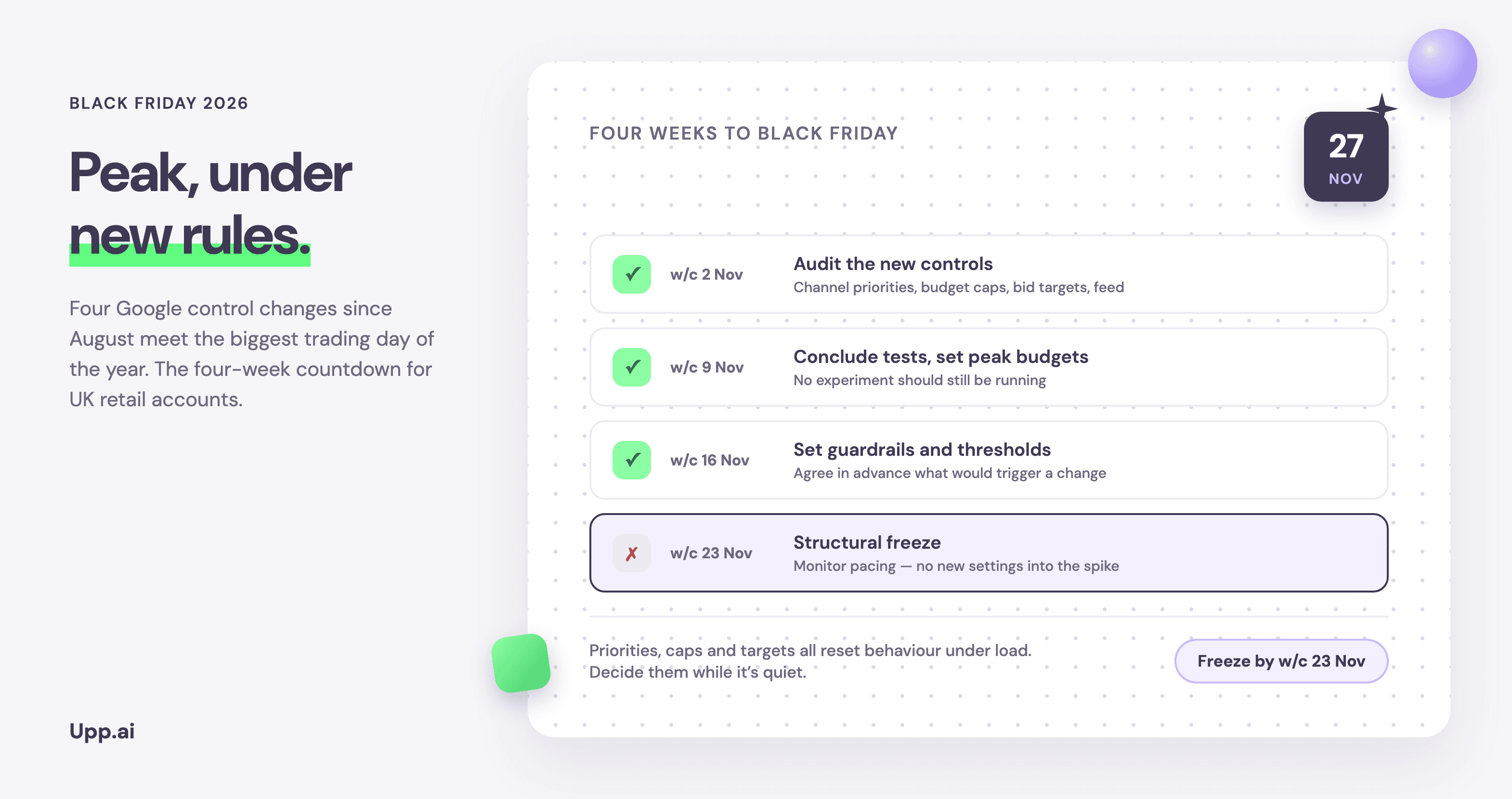
Black Friday 2026 PPC strategy: the first peak under Google's new controls
Black Friday lands on 27 November — the first peak since Google shipped four major control changes. The four-week countdown for UK retail accounts: what to audit, what to set, and what to freeze.
Upp.ai insights team
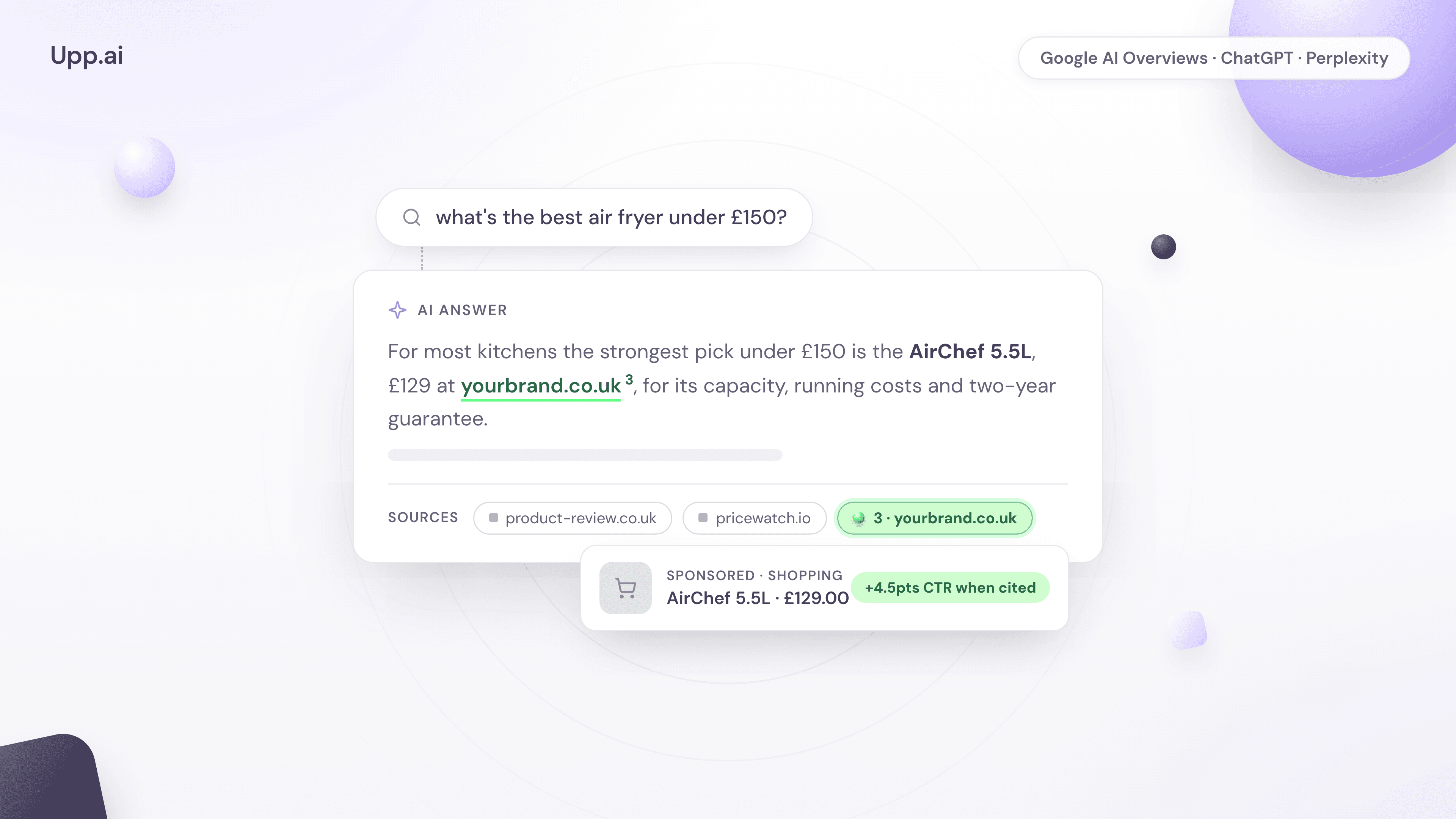
Answer engines don't click: what AEO and GEO mean for paid media
In two years, answer engine optimisation (AEO) and generative engine optimisation (GEO) have gone from SEO jargon to the fastest-rising discipline in search. The demand your campaigns bid on is increasingly read, and answered, by a model first. Here is what the answer layer means for paid media, and for the money behind it.
Upp.ai insights team
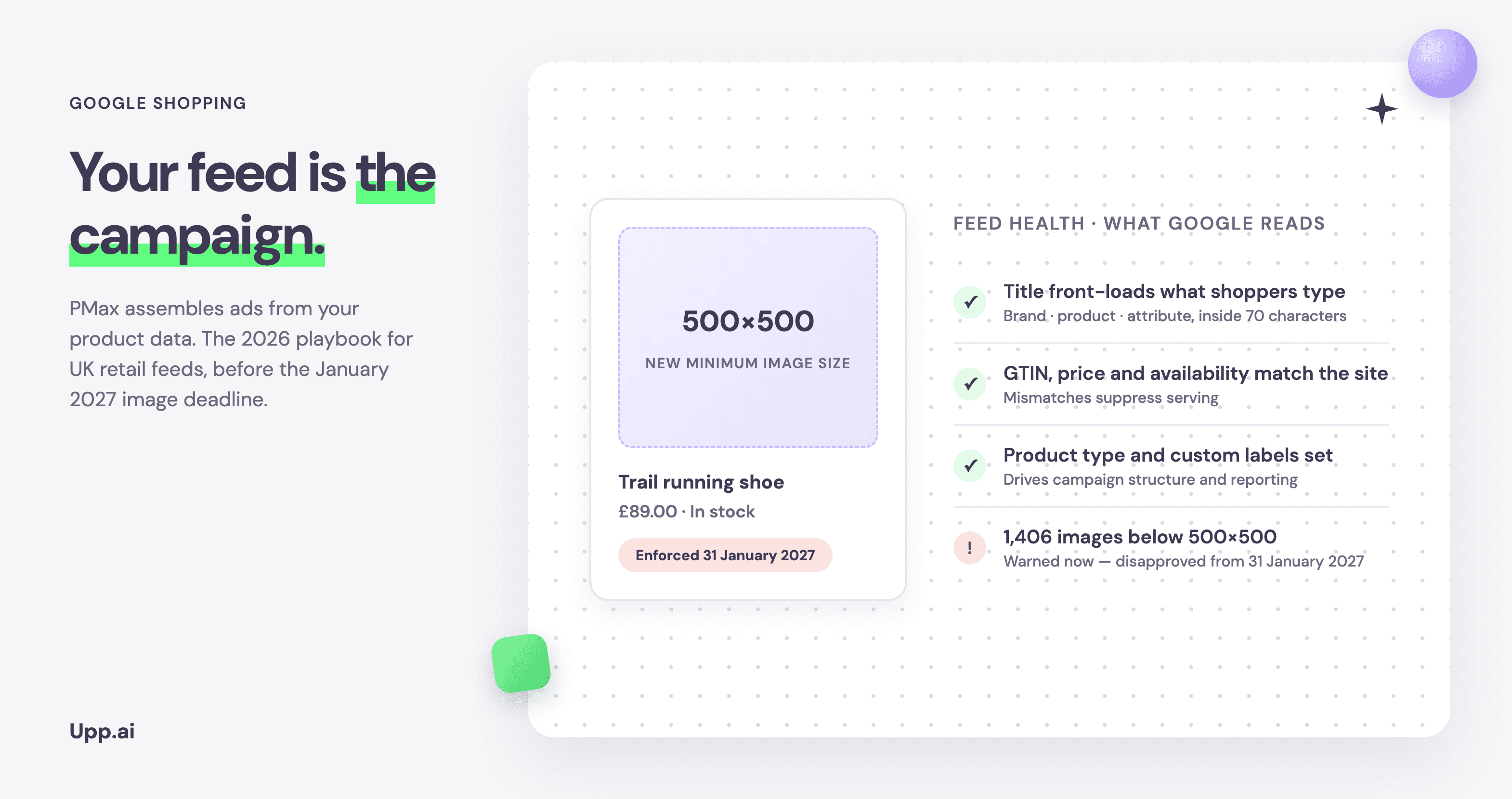
Google Shopping feed optimisation: the 2026 playbook for UK retail brands
PMax assembles your ads from your product data, so the feed decides which auctions you enter. A practical playbook for UK retail — and the 31 January 2027 image deadline to beat.
Upp.ai insights team