Media mix modelling for ecommerce: when MMM beats last-click
Last-click hands one channel the credit. MMM reads the whole mix. When each one is right for ecommerce budget decisions — and how to start before Q4 planning closes.

Every November, UK ecommerce teams sit down to divide next year's media budget, and most of them do it with a report that was never designed for the job. Last-click attribution — even its data-driven cousins inside the ad platforms — answers an operational question: which touchpoint should get credit for this sale? The planning question is different: where should the next pound go?
Media mix modelling exists for the second question. It is not new — consumer goods companies have used it since the 1960s — but three things have changed recently: privacy rules keep eroding the user-level tracking attribution depends on, open-source frameworks like Google's Meridian and Meta's Robyn have made the modelling accessible far below enterprise budgets, and the platforms themselves now recommend triangulating MMM with attribution and incrementality testing rather than trusting any single lens.
What media mix modelling actually is
At its core, MMM is a statistical model — usually regression-based — fitted to your weekly history. The inputs are the things that plausibly moved sales: spend by channel, pricing, promotions, seasonality, distribution or stock availability, and competitor noise where you can get it. The model estimates how much each input contributed, separating a base level of demand — what you'd sell with media off — from the incremental effect of each channel.
Two modelling ideas do most of the work, and both are worth understanding in plain terms:
- Adstock: advertising's effect doesn't vanish the day the spend stops. A burst of upper-funnel activity keeps nudging sales for weeks. The model carries spend forward with a decay rate instead of treating each week in isolation.
- Saturation: the first £10k in a channel buys more than the tenth. Response curves bend, and the bend is the point of the exercise — it tells you where the next pound stops paying back.
The outputs that matter for planning: a contribution split of revenue by channel, response curves per channel, and the ability to run scenarios — what does the model expect if search spend drops 20% and the saving moves to paid social? That scenario answer is what last-click structurally cannot give you.
Where last-click misleads ecommerce teams
Last-click's failure mode isn't randomness — it's systematic bias, which is worse, because it's confidently wrong in the same direction every month. It over-credits the channels closest to checkout: brand search, retargeting, and anything that intercepts a buyer who was already coming. It under-credits everything that created the demand upstream — and assigns exactly zero to channels without a click path at all.
The planning trap follows mechanically. Cut the “unprofitable” prospecting line, and nothing breaks for a quarter — last-click never valued it anyway. Then brand search volume quietly softens, the cheap converting clicks thin out, blended return sags, and the dashboard that caused the problem offers no explanation. Teams that have lived this cycle don't need convincing that credit and cause are different things.
Last-click doesn't measure what caused the sale. It measures what happened to be standing closest when the sale occurred.
When MMM beats last-click — and when it doesn't
The honest version of this comparison is that MMM and attribution aren't competitors. They operate at different altitudes, and the mistake is using either at the wrong one. MMM is slow, aggregate and causal-ish; attribution is fast, granular and credit-based. Match the tool to the decision:
There's also a floor below which MMM isn't the right spend. If your media mix is two channels and your trading history is eighteen months, a well-designed programme of incrementality tests will answer your allocation questions faster and cheaper than a model that will struggle to separate its variables.
What an ecommerce MMM needs to work
The model is the easy part now; the data discipline is the project. A workable ecommerce MMM wants weekly observations covering at least two years — enough to see two of each season — including total sales (not just last-click revenue), spend and impressions by channel, promotional calendar, pricing moves, stock availability on hero lines, and known demand shocks. Garbage in applies without mercy: a model that doesn't know about your 20%-off week will cheerfully credit that revenue to whatever channel spent most during it.
Three disciplines separate MMMs that change budgets from MMMs that decorate slide decks:
- Calibrate against experiments. Feed lift-test results into the model as ground truth. A model that disagrees with a clean holdout test is wrong about that channel, and modern frameworks let you encode the test result as a prior.
- Refresh quarterly. An annual MMM is a photograph of last year. Response curves move with competition, pricing and creative quality; a model refreshed quarterly keeps the planning conversation attached to the current market.
- Pre-agree the decisions it informs. Before results arrive, agree what moves money: which scenarios get run, what confidence triggers a reallocation, who signs it off. Otherwise the model becomes ammunition for whichever argument existed already.
The 2026 measurement stack: triangulate, then operate
Put the three lenses together and each covers the others' blind spots. Attribution gives practitioners fast, granular feedback for in-channel work. Incrementality tests prove causation where the stakes justify a holdout. MMM allocates across the whole mix, calibrated by the tests, sanity-checked against the blended metrics finance already trusts.
The remaining gap is cadence. A quarterly model refresh and a quarterly test cycle still leave the plan static for twelve weeks at a time, while demand, competitors and stock move weekly. The teams getting ahead aren't just triangulating better — they're closing the loop between what measurement says and what the account does, continuously, inside guardrails they control.
Frequently asked questions
What is media mix modelling?
A statistical technique that estimates how much each marketing channel — along with price, promotions and seasonality — contributed to sales, using aggregate time-series data rather than user-level tracking. Its outputs include channel contribution splits, diminishing-returns curves and budget scenarios.
How is MMM different from attribution?
Attribution assigns credit for individual tracked conversions among the touchpoints that preceded them. MMM models the relationship between spend and total sales over time, so it captures effects attribution can't see — offline channels, upper-funnel carryover and base demand — and needs no user-level data to do it.
How much data does MMM need?
A common working floor is two years of weekly observations: sales, spend by channel, pricing, promotions and seasonality. Less history is workable with modern Bayesian frameworks and informative priors, but confidence intervals widen — and the model leans harder on calibration from incrementality tests.
Is MMM accurate enough for ecommerce budget decisions?
Used correctly, yes — for the decisions it's built for. MMM produces estimates with uncertainty, so treat outputs as ranges, calibrate against holdout experiments, and use it for cross-channel allocation rather than campaign-level tuning. The relevant comparison isn't MMM versus perfect truth; it's MMM versus planning on last-click.
Should I use MMM or incrementality testing?
Both, for different jobs. Lift tests prove what a specific channel caused at today's spend level; MMM allocates across the whole mix and finds saturation points. The strongest set-ups feed test results into the model as calibration — proof and planning reinforcing each other.
Sources: Google's open-source Meridian MMM framework and measurement guidance; Meta's Robyn project. Contribution figures in this article are illustrative.
Move your paid media to AI
Plan next year's budget on evidence, not last-click's story. See how Rubin Plan keeps the plan true all year.
Keep reading
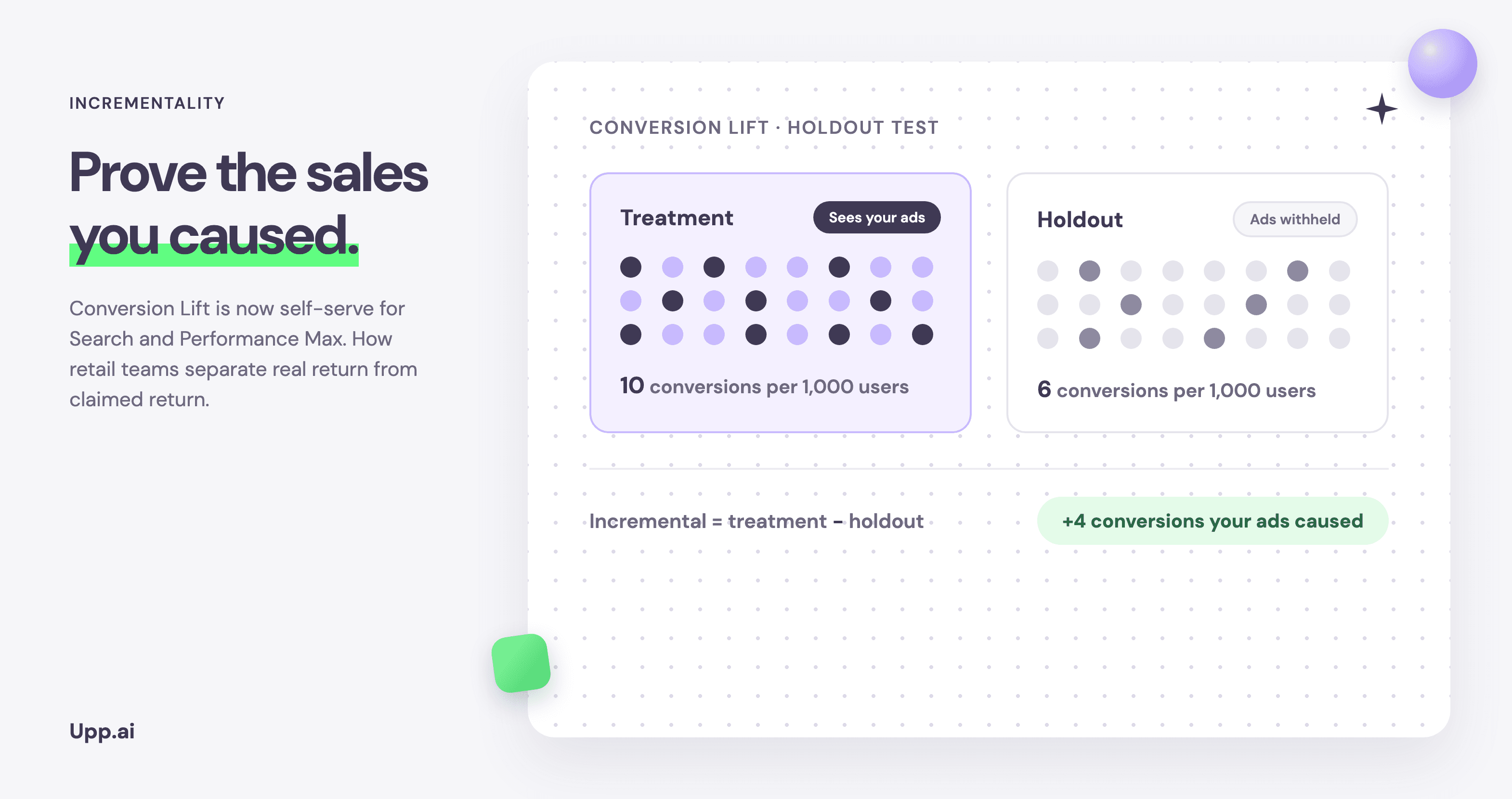
Incrementality testing for retail PPC: how to prove true ROAS
Google has made Conversion Lift self-serve for Search and Performance Max. How to run holdout tests that separate the sales your ads caused from the sales you'd have made anyway.
Upp.ai insights team
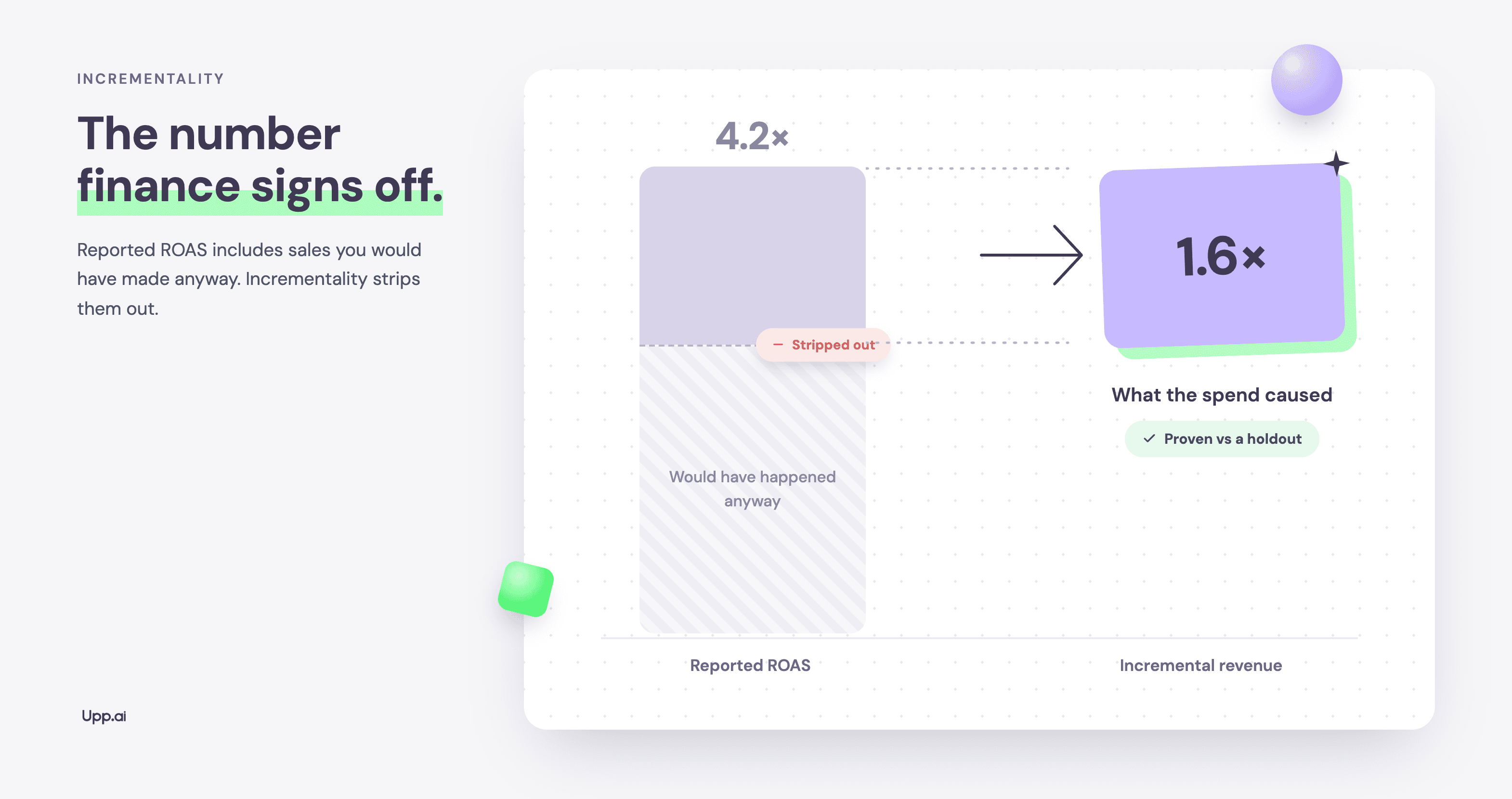
Why incrementality has replaced ROAS as the measure that matters
Finance is now asking a different question, and incrementality is the only lens that answers it.
Upp.ai insights team

If the plan doesn’t work, why does measurement keep pretending it does?
Discover how retail measurement can evolve from merely explaining performance to guiding actionable decisions, enhancing confidence and adaptability in a changing market.
Upp.ai team