Meta's 2026 algorithm update: what GEM and Andromeda mean for retail advertisers
Meta rebuilt ads delivery around one central AI model and claims 18.9% more conversions — with no setting to check and no baseline to verify. What GEM, GenRecs and Andromeda change, and the number that's actually on your invoice.
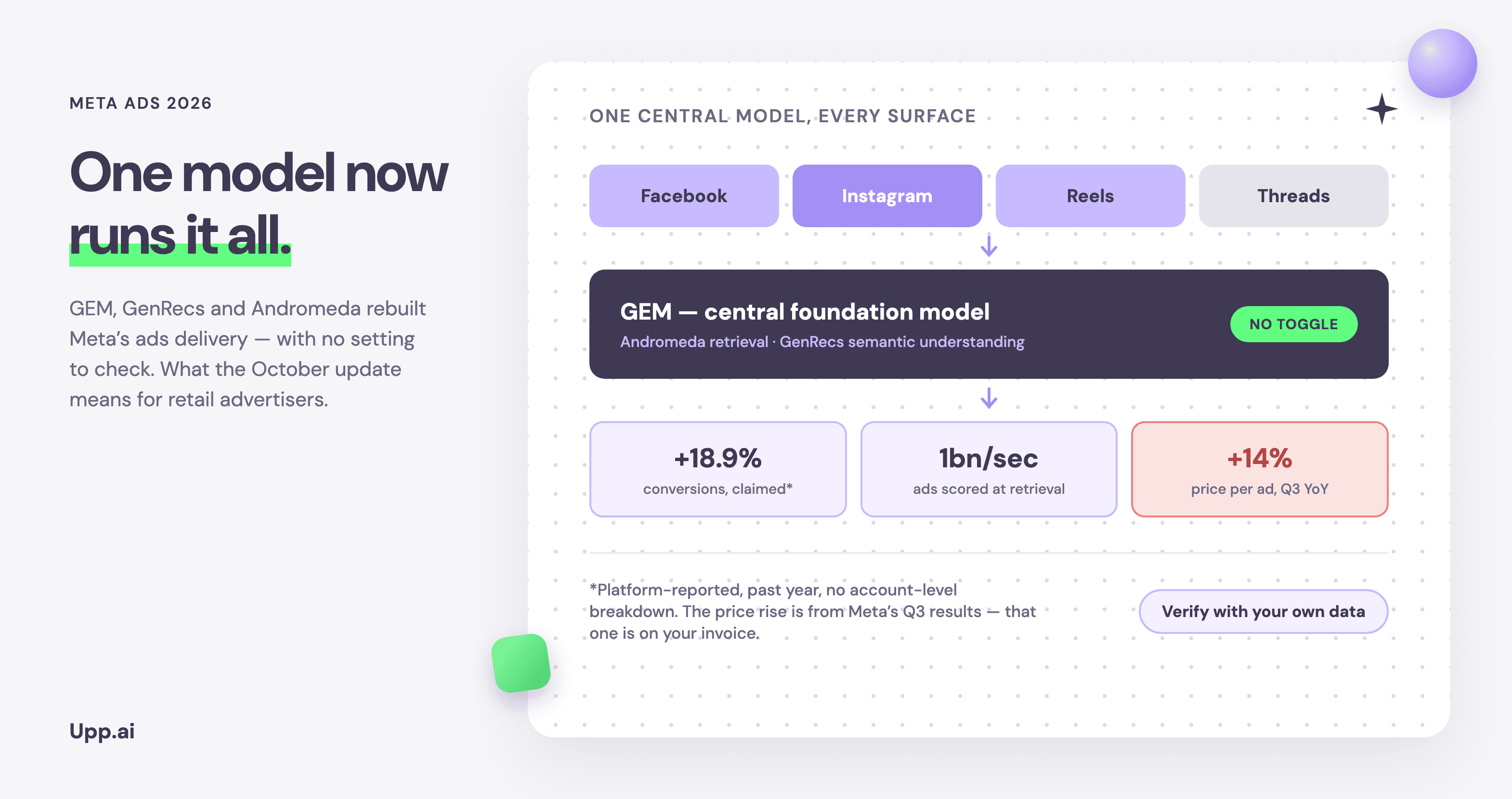
In the space of sixteen days this October, Meta's engineering team published three posts that together describe the biggest rebuild of its ads delivery system since Advantage+ launched. GEM, Meta's recommendation foundation model, now runs as one central brain across Facebook, Instagram and Reels instead of separate systems per surface. GenRecs Tokenization gives that brain an LLM's world knowledge about what an ad actually is. And a new generation of Andromeda, the retrieval engine, now scores every eligible ad for every impression at over a billion ads per second — a hundred times the 2024 system's throughput.
If you manage retail spend on Meta, two things make this more than engineering news. First, it is already live in your account: there is no opt-in, no toggle and no setting to review. Second, it continues a direction UK retail teams will recognise from Google's year — the platform absorbs another layer of decisions that practitioners used to make, and the claimed gains arrive platform-reported, with no way to reconcile them in Ads Manager.
This guide covers what Meta actually changed, what it means inside the account, why creative has become the targeting layer, and the measurement catch — including the one number in this story you can verify, because it appears on your invoice.
What Meta actually changed
The three announcements describe one pipeline. Retrieval decides which ads are even considered for an impression; ranking decides which of those survivors is shown; and a foundation model teaches both. Each October post upgrades one stage:
- GEM became the central model. Previously, Facebook, Instagram and Reels each had their own prediction systems. The 2026 generation of GEM is a single LLM-style foundation model — 2.5 times the complexity of last year's, trained on four times the compute — that learns across every surface and objective at once, reading twice as much user history. It is too large to run in a live auction, so it works as a teacher: its intelligence is distilled into the hundreds of smaller models that actually pick ads in real time.
- GenRecs gave the system world knowledge. Historically, ad delivery learned from engagement signals — IDs and clicks, not meaning. GenRecs Tokenization lets the models reason about what an ad semantically is, which matters most where engagement data is thin: new products, new creative, new advertisers.
- Andromeda made retrieval near-exhaustive. The new retrieval engine scores every eligible ad with near ranking-level model quality, at over a billion ads per second. In plain terms: the first cut, where most ads used to be filtered out by cruder heuristics, is now almost as intelligent as the final ranking.
Meta's claimed results: 18.9% more conversions and 12% higher click-through rates across surfaces and objectives over the past year from GEM, plus 2.4% more Facebook conversions from Andromeda since 2025, and a further 0.35% from GenRecs. More on those numbers below — they deserve scrutiny.
What it means in the account
The practical shift is that another set of levers has moved from your side of the table to Meta's. Placement controls have been stripped back over the year, audience segmentation keeps losing ground to model-selected delivery, and the new stack is explicitly designed to need less of both. Meta's VP of ads ranking, Matt Steiner, put it plainly to AdExchanger: “the importance of targeting is diminishing over time as ranking models get better at selecting who an ad would be relevant for” — and advertisers shouldn't spend their time “trying to outperform the machine at pulling mechanical levers.”
One nuance worth knowing: because the gains flow through automated delivery, they are not evenly distributed. Advantage+ campaigns with broad targeting and rich creative sit closest to the new model's strengths; tightly constrained manual set-ups feel the improvements second-hand. That is not a reason to surrender every control — it is a reason to be deliberate about which constraints still earn their keep.
Creative is the new targeting
If the model picks the audience, what decides your reach? Increasingly, the variety of what you give it to work with. Meta's delivery system groups visually and thematically similar ads into a single creative entity — ten near-identical product shots register as one ad, however much budget sits behind them. A genuinely diverse creative set gives the model more distinct entities to match against more segments and moments; a narrow one caps reach regardless of spend.
GenRecs sharpens this further. A system that semantically understands ad content can place strong new creative well before it has engagement history — which shortens the cold start that used to punish fresh assets, and rewards teams that produce distinct creative families rather than variations on one winner. The job description changes from asset production to input curation: what the model learns about your products is now something you actively manage, the same way feed quality decides your Shopping visibility on Google.
Meta's claimed uplifts, side by side
The measurement catch
Here is the market's near-unanimous reading of those numbers, and we share it: they are directional claims about delivery quality, not forecasts for your account. There is no baseline attached, no method, and no way to see GEM's contribution in your reporting. The 18.9% headline and the 5.8% Facebook figure measure different things across different populations, and Meta hasn't published the reconciliation. None of that makes the gains fake — it makes them unverifiable from where you sit.
What is verifiable sits in Meta's Q3 2026 results: ad revenue up 26% year on year to $63.1 billion, driven by 10% more impressions and an average price per ad up 14%. Better delivery lifts auction prices — the model's gains are partly priced in, and UK advertisers have also carried a location fee on UK-delivered ads since July. So judge this update the way you'd judge any platform claim: against the metrics that still mean something — blended MER, new-customer share, margin — and let an incrementality test establish what Meta actually adds. At the planning level, media mix modelling is where a 14% price rise and a claimed conversion gain get weighed against each other honestly.
Timing matters too: this model took over delivery in the run-up to peak. If your November numbers move, the honest answer to “was that us, the model, or Black Friday?” is an independent measurement plan agreed before the spike — not a screenshot of platform-reported ROAS.
The uplift is platform-reported. The 14% rise in price per ad is on your invoice.
Your levers changed. Your job didn't.
It is reasonable to feel that each of these updates takes something away — the placement grid, the audience matrix, the sense that skill with the settings was the craft. But the craft was never the settings. It was deciding what the spend should achieve, feeding the system inputs worth amplifying, constraining it where the business requires, and proving what came back. Meta's new model does the mechanical parts faster than any human. It cannot decide your strategy, curate your inputs or audit its own claims. That remains the work — on Meta, on Google, and on whatever surface comes next.
Frequently asked questions
What is Meta's GEM model?
GEM (Generative Ads Model) is Meta's ads recommendation foundation model. The 2026 generation is a single LLM-style central model that learns across Facebook, Instagram, Reels and every advertiser objective at once. It is too large to run in live auctions, so it acts as a teacher model whose intelligence is distilled into the smaller models that select ads in real time.
What did Meta change in October 2026?
Three engineering announcements: the 2026 generation of GEM (13 October), GenRecs Tokenization, which adds semantic understanding of ad content (19 October), and a new Andromeda retrieval engine that scores every eligible ad at over a billion ads per second (28 October). Together they rebuild delivery around one central model with smarter retrieval and matching.
Do I need to change any settings to benefit?
There are no settings — the update has no toggle, no opt-in and no account-level changelog. The gains arrive through automated delivery and land most directly on Advantage+ campaigns with broad targeting and diverse creative. The controllable inputs are creative diversity, catalogue and signal quality, and the guardrails you set around spend.
Why has my Meta performance shifted without changes on my side?
Delivery model updates are the usual suspect: Meta ships them continuously and the October rebuild is the largest in years. Check whether the shift coincides with CPM movement — average price per ad rose 14% year on year in Q3 — and with seasonal demand, before attributing it to anything you did. A stable measurement baseline is the only reliable way to separate the three.
How do I verify Meta's claimed 18.9% improvement in my own account?
You can't directly — the figure is platform-reported with no baseline or account-level breakdown. What you can do is hold Meta to your own numbers: trailing CPA and MER before and after, judged over weeks not days, and an incrementality test that measures what Meta spend adds against a holdout. If the model is genuinely better for your account, independent measurement will show it.
Sources: Meta engineering posts on GEM, GenRecs Tokenization and Andromeda (October 2026); Meta's Q3 2026 results (21 October 2026); AdExchanger's interview with Meta's VP of ads ranking (28 October 2026). All uplift figures are Meta's own.
Move your paid media to AI
Meta reports its own uplift. Rubin Measure proves what your spend actually adds — independently, channel by channel.
Keep reading
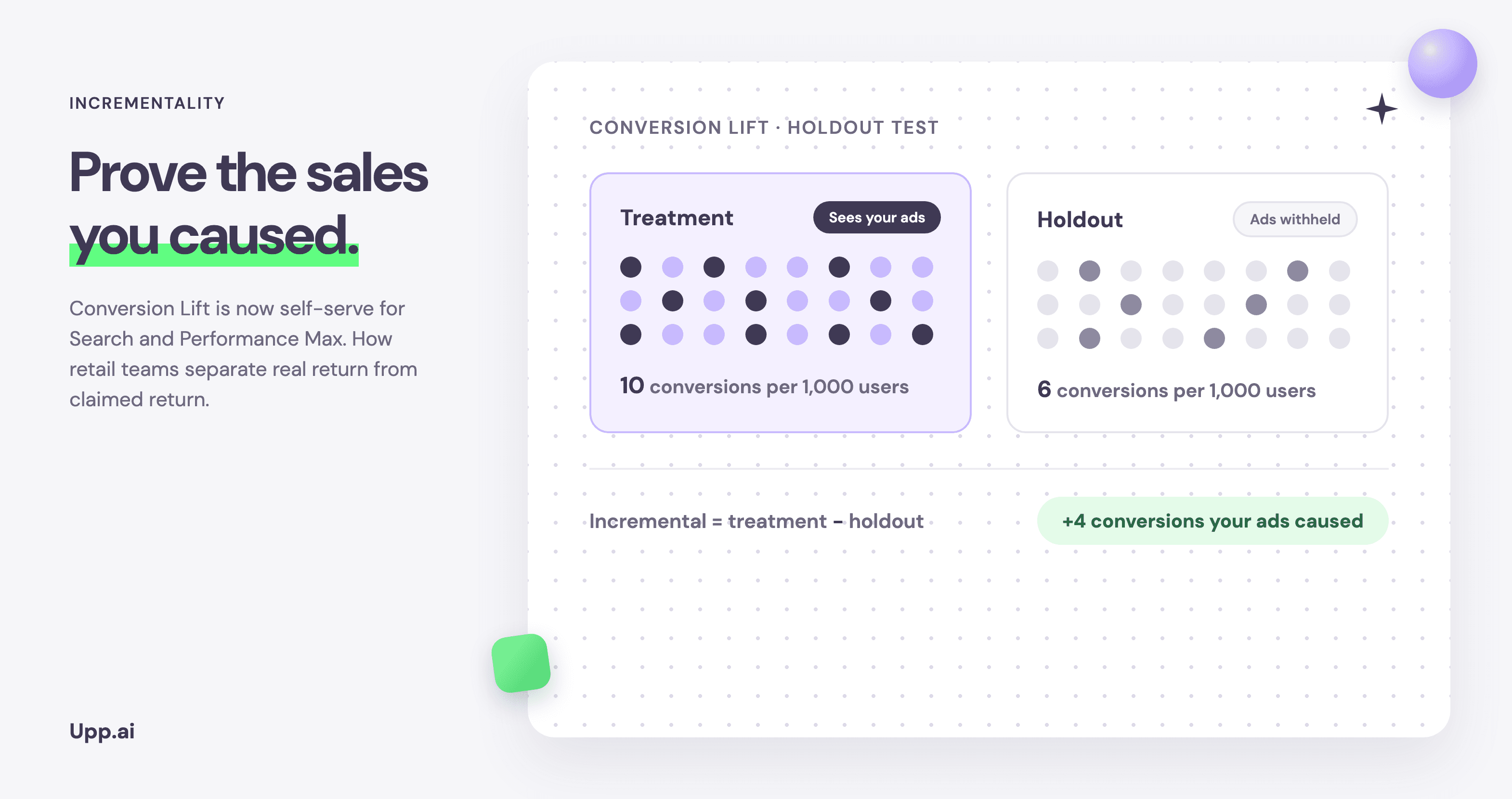
Incrementality testing for retail PPC: how to prove true ROAS
Google has made Conversion Lift self-serve for Search and Performance Max. How to run holdout tests that separate the sales your ads caused from the sales you'd have made anyway.
Upp.ai insights team
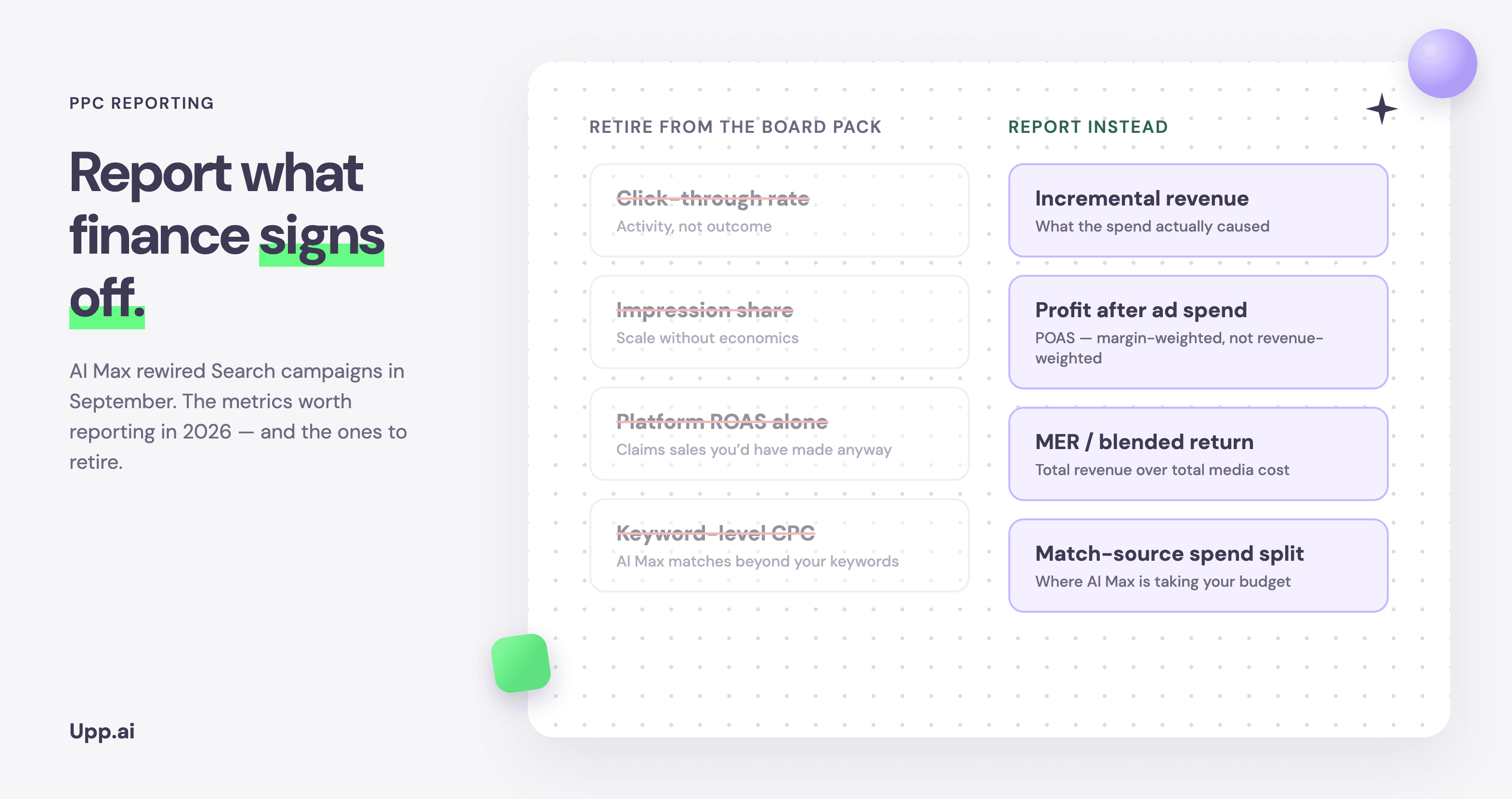
PPC reporting in 2026: what metrics actually matter after the AI Max migration
September's AI Max migration quietly rewired how Search campaigns match and report. The metrics worth presenting now, the ones to retire from the board pack, and how to reconcile the change.
Upp.ai insights team
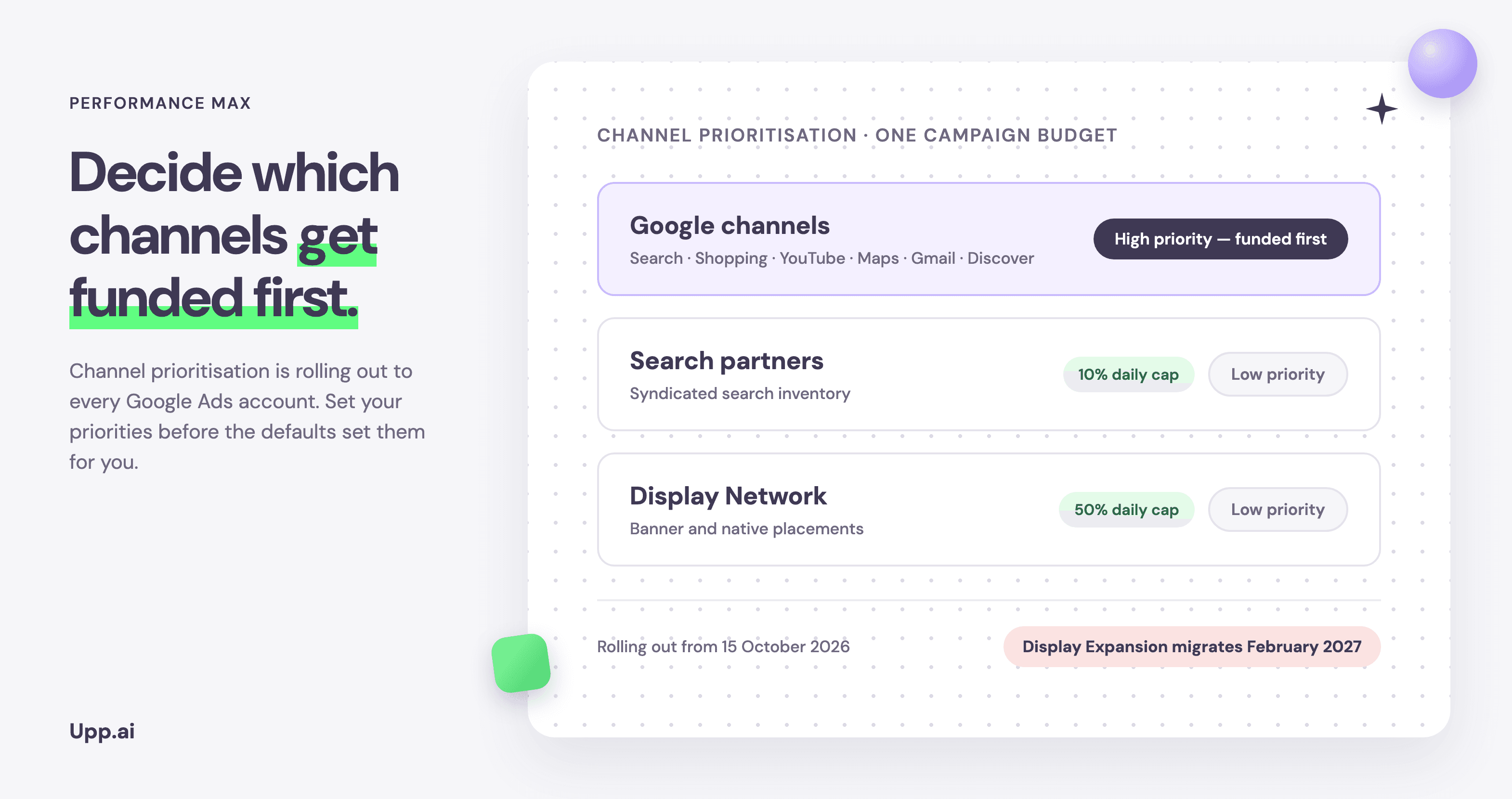
Performance Max channel prioritisation: the complete UK ecommerce guide
Google is rolling out channel prioritisation and budget allocation controls from 15 October. What UK retail teams can set inside PMax, what they still can't, and the February 2027 date to diary.
Upp.ai insights team