Win peak on Meta: the 2026 peak season playbook for retail brands
Black Friday is 27 November and the surge lasts days, not weeks. This is the playbook our strategists use to get retail Meta accounts peak-ready: fix, build, freeze, scale — plus the six priorities and the peak-day rules, built on Meta's 2026 festive research.
Black Friday falls on Friday 27 November this year, Cyber Monday on the 30th — and Meta is where festive shoppers already are. In Ipsos research for Meta across 18 markets including the UK, 85% of festive shoppers used a Meta technology weekly, ahead of YouTube at 63% and TikTok at 41%, and 81% of EMEA shoppers took part in Black Friday sales — the highest of any region.
Last season's auction data carries a sharper lesson: the peak is not a six-week plateau but a handful of days when conversion rates spike faster than costs rise. The season is decided before it starts — by whether signals, catalogue, creative and the budget plan were in place when the surge arrived. Accounts still fixing tracking during Black Friday week in 2025 simply missed it.
This is the public version of the peak playbook our client strategy team prepares each autumn, built on Meta's 2026 festive research and last season's benchmark data: the surge timeline, a week-by-week readiness plan, the six priorities that separate strong peaks from average ones, and the rules for the peak days themselves. It is Meta-specific by design — for the cross-channel view, start with our Black Friday 2026 PPC strategy.
The surge lasts days, not weeks
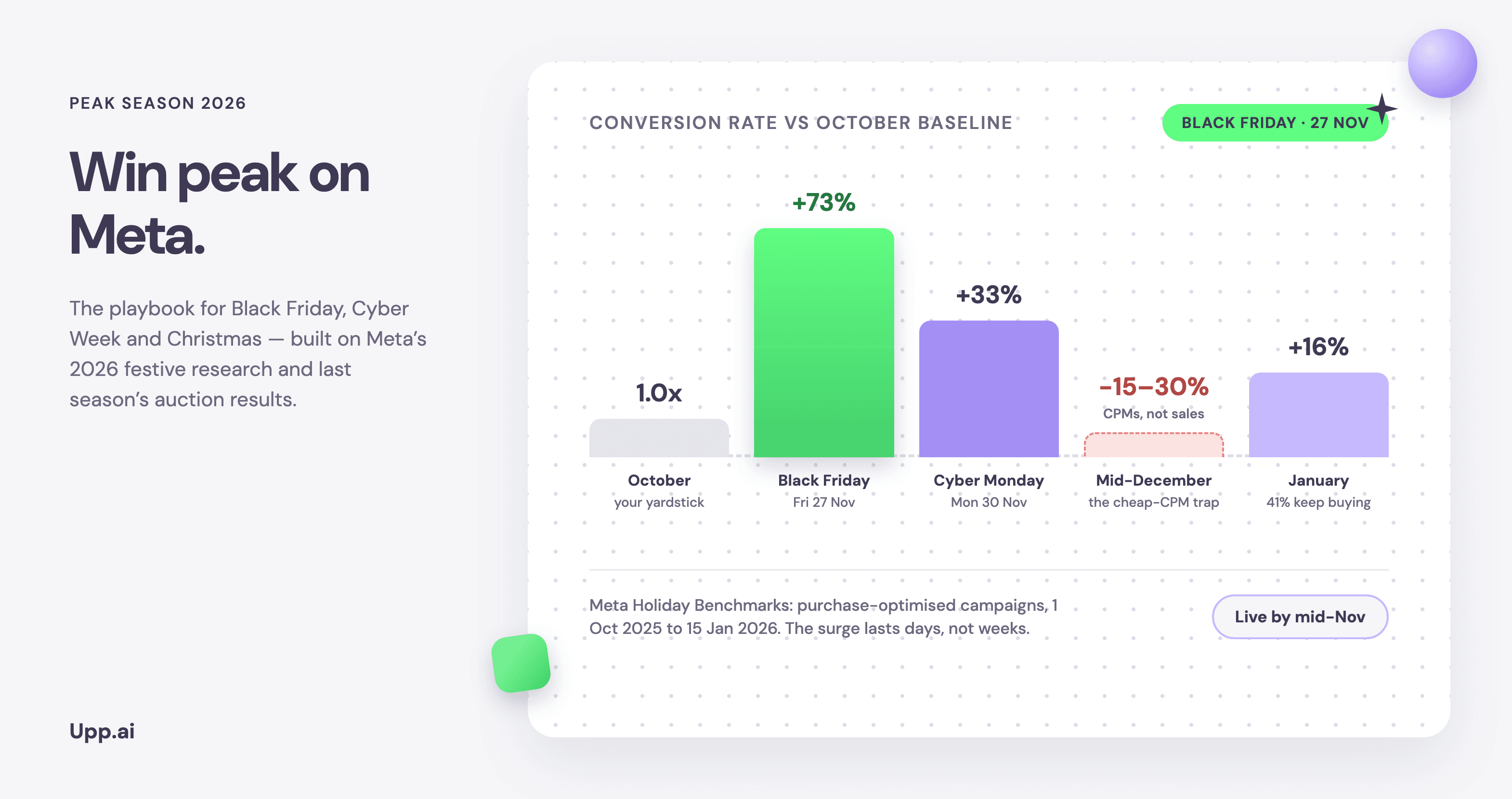
Meta benchmarks every peak metric against early October — your own October numbers are the yardstick the season will be measured against. From there, the 2025 shape was consistent: CPMs rose into Black Friday, but conversion rates rose faster — up 73% on the day with cost per action down 11%. The Cyber 5 weekend lifted conversion rates around 30% across shopping and non-shopping categories, and Cyber Monday closed 33% above October with cost per action down 9%.
Conversion rate vs the October baseline, 2025 season
The operational consequence: anything new must be live and out of the learning phase by mid-November, because a campaign still calibrating on 27 November is learning through the most expensive, least representative days of the year. The stakes are higher this season, too: Meta's October rebuild of ads delivery removed another layer of mechanical levers, so delivery leans harder on what you feed it — conversion signals, catalogue quality and creative variety. The playbook below is organised around exactly those inputs.
Three weeks out: fix, build, freeze, scale
Meta advises finishing peak setup in Q3. If yours is not complete, there is still time — provided the work lands in the right order, one job per week.
This week — fix (w/c 2 November)
Foundations first, because peak tests your setup before it tests your strategy. Meta's November 2025 experiment across 5,926 advertisers measured a 17.8% lower CPA when the pixel and the Conversions API run together rather than the pixel alone. Complete by Friday 6 November:
- Signals: pixel firing on every key event from PageView to Purchase, Conversions API live and deduplicated with matching event IDs, event match quality 6.0 or above (8 to 10 on Purchase), and purchase value and currency on every event, spot-checked against 20 to 30 real orders.
- Catalogue: feed errors cleared, hourly feed updates on for peak, images at 500×500px or larger, and a catalogue match rate at 90%+ (75% is the minimum worth going into peak with).
- Plan: offers, discount depths and timings confirmed for each date; a day-by-day budget for 20 November to 2 December; attribution settings documented and locked until January.
W/c 9 November — build
Launch anything new now so it exits learning before the spike: new campaigns, festive product sets, and any first-time Advantage+ sales campaign by Friday 13 November. Load Black Friday ads this week, scheduled to start on the day, and brief 9:16 sound-on video and creator assets now — creator partnership-ad permissions take longer than teams expect.
W/c 16 November — freeze
Last structural change by Friday 20 November. From here campaigns exit the learning phase untouched: no new audiences, objectives or optimisation events. What remains is governance — budget steps, who signs off in-flight increases, and the escalation route for when something looks wrong at 7am on the day.
W/c 23 November — scale
Raise budgets behind proven campaigns in steps under 20%, monitor daily, and keep everything running through Cyber Monday. The build is done; the job now is controlled adjustments, not reinvention.
Six priorities that decide your peak
Behind the week-by-week plan sit six priorities. Each one is a place where last season's data shows a measurable gap between accounts that prepared and accounts that reacted.
- Lock your signal foundations. Everything Meta's delivery does at peak depends on clean purchase signals and clean product data — the fix-week checklist above compounds through every other item on this list.
- Lean into Advantage+ where your signals allow. Automation amplified the Black Friday surge in 2025 (chart below); consolidate small ad sets so each sees enough conversions to optimise. Value (ROAS) optimisation added 12% ROAS and 37% incremental ROAS on top, but it has entry rules — covered in the FAQ — and needs three weeks to judge. If you cannot start this week, test it in January.
- Build a gift-ready catalogue. Festive product sets — bestsellers, gift guides by price point and recipient, high-margin lines, post-Christmas clearance — each with 50+ products so catalogue ads can optimise. Add custom labels for margin tier and seasonality, and put price, discount and delivery overlays in the ad itself. Meta's causal analysis of 108,000 ad accounts put Advantage+ catalogue ads at 16.4% lower CPA than static ads, and the same feed-quality principles decide your Google Shopping visibility.
- Feed the auction with the right creative. In a crowded auction the right format costs less: 9:16 sound-on video saw CPM inflation of 48% on Black Friday against 61% for other formats, and format display options added 23% more conversions from the same assets. 94% of social shoppers look to creators for festive guidance — reviews, deals, promo codes and demos. Brief at least three asset types, with Black Friday, gifting and January versions ready before peak.
- Phase budget to when your customers actually buy. Black Friday conversion lift varies enormously by age: +190% for 55 to 64s against +30% for 18 to 24s. Older customers wait for the deal and convert decisively — concentrate budget into Black Friday week. Younger ones spread across the season: ease off Christmas week, when their cost per result rose about 50%, and re-engage in January. Judge peak on CPA and ROAS, never on CPM.
- Measure what is incremental. Advertisers who connected store sales and ran online and in-store together saw CPA fall 21% on Black Friday; online-only advertisers saw it rise 8% — and 85% of social shoppers have bought in store after seeing a product on social, so online-only reporting understates Meta's contribution. Pull a 30-day baseline now, keep attribution settings fixed until January, and if budget allows, book a conversion lift study — then report cost per incremental conversion next to blended CPA.
Black Friday 2025 vs October: Advantage+ sales vs without
During the peak days: do this, avoid that
Done right, the peak days themselves are deliberately boring. The learning phase resets on budget moves above roughly 20% and on any audience, creative or objective change — and a campaign relearning on 27 November is paying peak CPMs for calibration traffic.
If the setup is done right, peak becomes four jobs: scale budgets, expand creative, monitor health, stay calm.
After Cyber Monday: Christmas needs a different plan
From 1 December to your last delivery date, the job is gifting: swap to gift-guide product sets and Christmas creative, show delivery deadlines in overlays as they approach, and refresh creative as frequency builds on audiences you saturated in Black Friday week.
Between the last delivery date and 24 December, do not chase cheap CPMs. In 2025, Western European CPMs fell 15 to 30% as advertisers pulled back — but conversion rates fell in step, so the bargain reach converted no better. Trim spend to what still transacts: click and collect, store visits, gift cards.
Then stay on. From Boxing Day to the end of January, CPMs ran about 6% below October while conversions ran 16% above. Competitors switch off in January; brands that keep spending meet lower auction costs and continued purchase intent. Have sale and new-year creative loaded before 24 December, with clearance product sets ready for Boxing Day.
The hard part is not the plan. It is holding to it.
Every rule here is easy to agree in a planning meeting and hard to hold at 9am on 27 November, when CPMs are spiking and someone senior is asking why the budget has not doubled. That pressure is why the plan gets agreed in writing now — day-by-day budgets, step sizes, sign-off — so peak-day decisions are executions of a plan, not reactions to a dashboard. Teams that lose peak are rarely short of effort; they are short of a pre-agreed answer to “should we change something?”
Frequently asked questions
When does everything need to be live for Black Friday 2026?
Work backwards from Friday 27 November: foundations fixed by Friday 6 November, any first-time Advantage+ sales campaign live by Friday 13 November, and the last structural change by Friday 20 November so campaigns exit the learning phase before the surge. Black Friday ads can be loaded early and scheduled to start on the day.
Should I switch to value (ROAS) optimisation before Black Friday?
Only if you qualify this week: purchase values passing QA on every event, six or more products across roughly a 3x price range, and ad sets seeing 30+ conversions a day. Set the ROAS goal 10 to 20% below your historical average and expect fewer, higher-value orders. It needs about three weeks to judge — if you cannot start by 6 November, test it in January's low-cost window instead.
How much can I raise budgets without resetting the learning phase?
Keep increases under roughly 20% per step; larger jumps — like changes to audiences, creative, objectives or optimisation events — can push a campaign back into learning at the year's highest CPMs. Plan the steps day by day for 20 November to 2 December, and agree who signs off an unplanned increase.
Should I pause campaigns between Black Friday and Cyber Monday?
No. Pausing over the weekend discards learning you paid Black Friday prices to accumulate, and the Cyber 5 weekend held conversion rates around 30% above October. Run continuously through Cyber Monday, then switch to gifting sets and Christmas creative.
Is January worth paid social budget for retail?
On last season's numbers, yes: conversions ran 16% above October with CPMs about 6% lower, 41% of shoppers kept buying after the festive season, and the 55 to 64 audience recovered fastest — up about 60% by mid-January. Auctions are cheaper because competitors switch off, and it is the right window to test what peak would not allow: value optimisation, new audiences, a conversion lift study.
Sources: Meta Festive Season Insights Centre, July 2026 — the Ipsos Holiday Shopping Study for Meta (November 2025; 14,473 festive shoppers across 18 markets including the UK) and Meta Holiday Benchmarks (purchase-optimised campaigns, 1 October 2025 to 15 January 2026, daily medians per advertiser normalised to a 1 October baseline) — plus the 2026 Meta Festive Season Guides (Investment Case, Experienced Advertisers, Creative and Agency editions). Figures are Meta's global or regional medians and Meta-reported results: a guide, not a guarantee. Your own October baseline is the benchmark your peak will be measured against.
Move your paid media to AI
Three weeks is enough time — if the fixes land this week. Upp.ai audits your account against this playbook: signals, catalogue, creative and the budget plan, scored before peak.
Keep reading
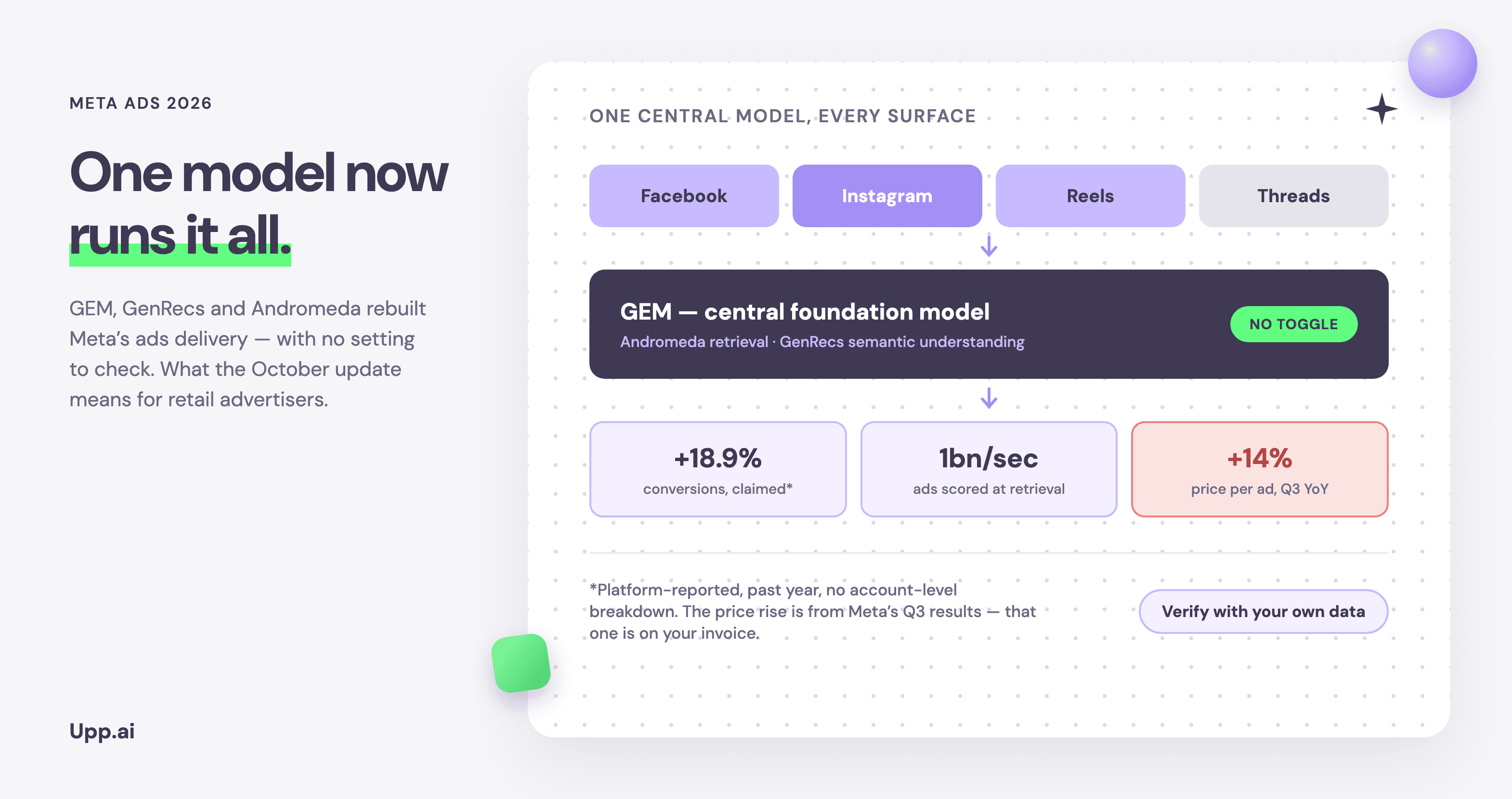
Meta's 2026 algorithm update: what GEM and Andromeda mean for retail advertisers
Meta rebuilt ads delivery around one central AI model and claims 18.9% more conversions — with no setting to check and no baseline to verify. What GEM, GenRecs and Andromeda change, and the number that's actually on your invoice.
Upp.ai insights team
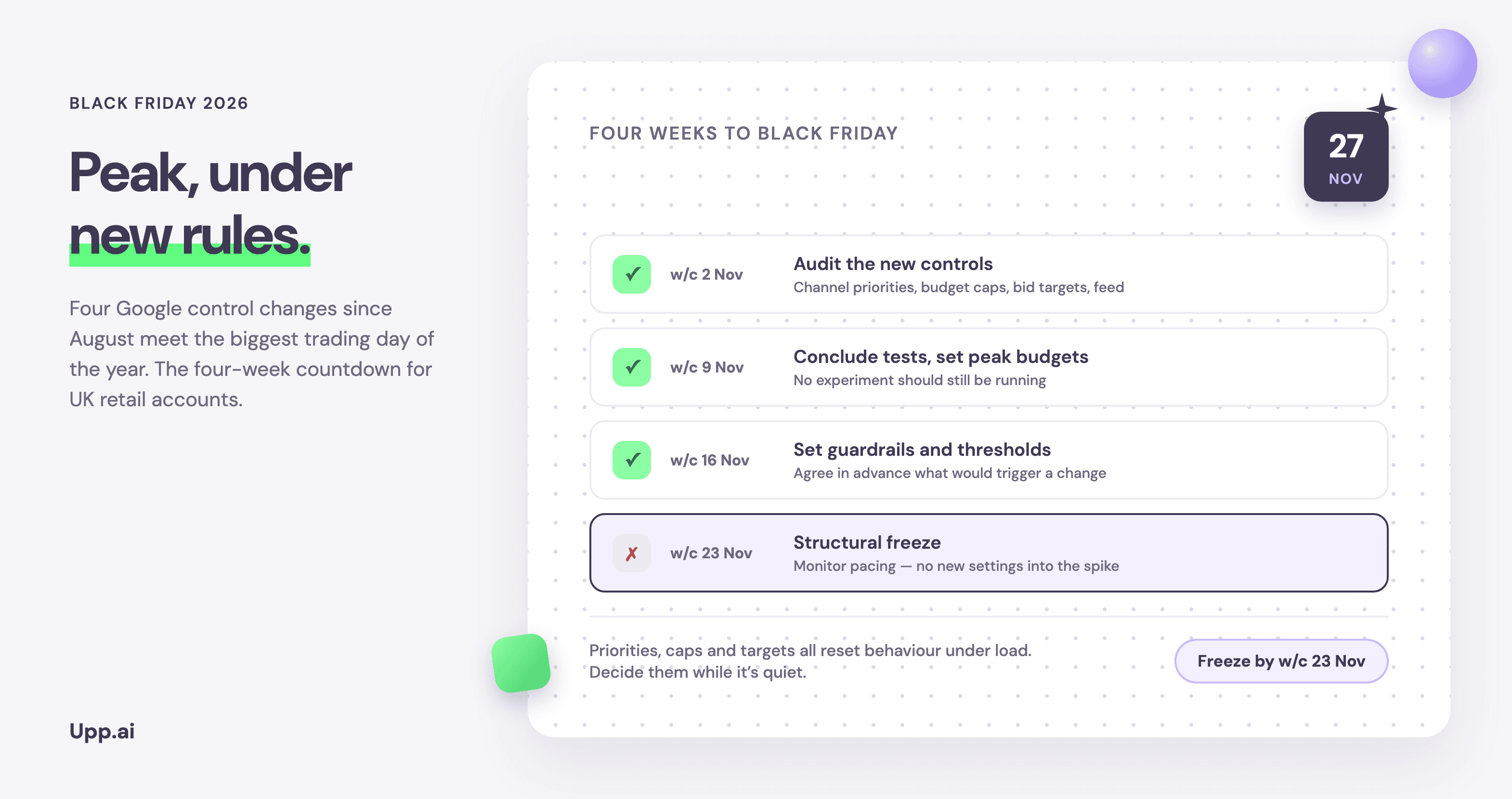
Black Friday 2026 PPC strategy: the first peak under Google's new controls
Black Friday lands on 27 November — the first peak since Google shipped four major control changes. The four-week countdown for UK retail accounts: what to audit, what to set, and what to freeze.
Upp.ai insights team
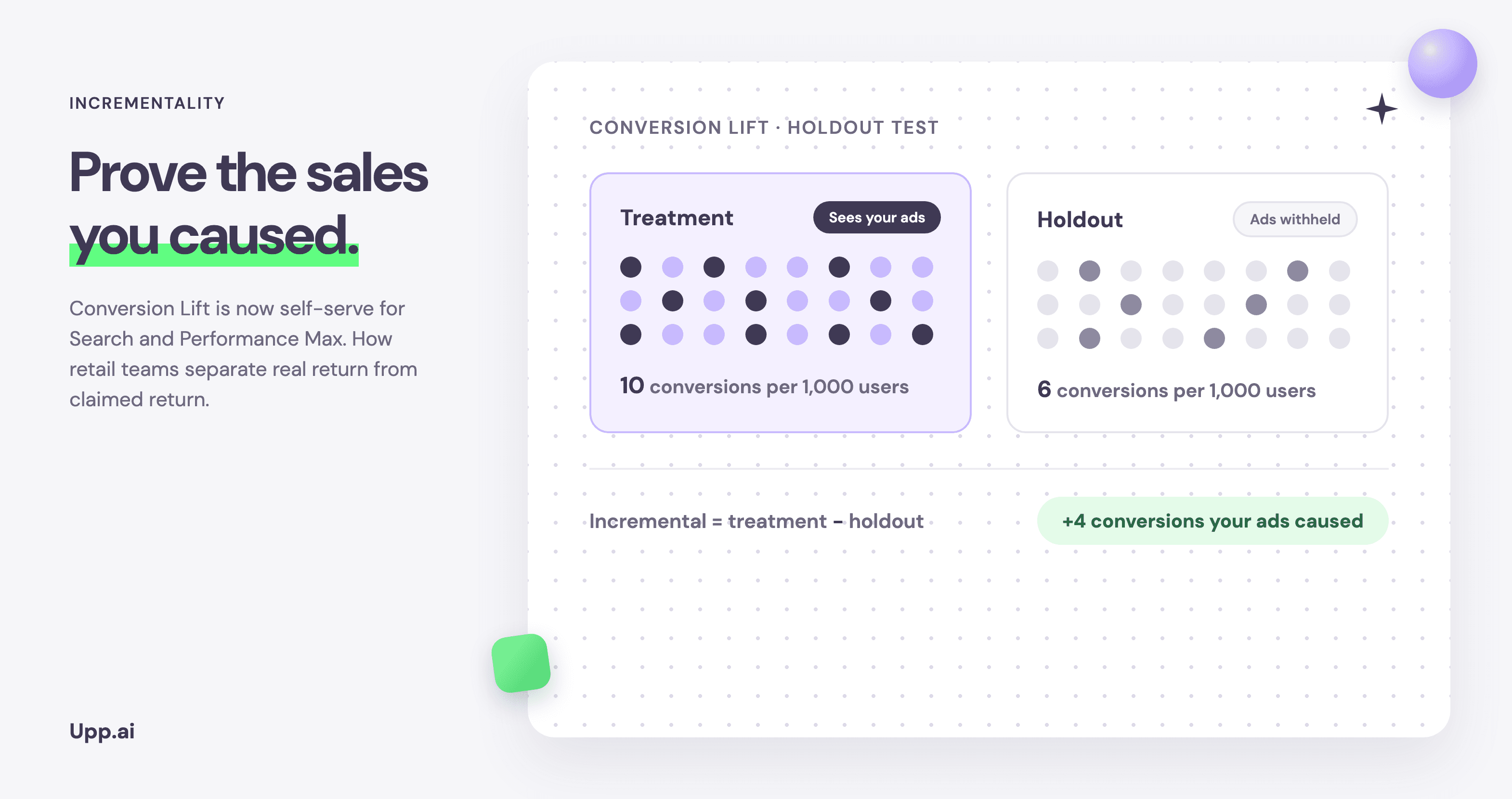
Incrementality testing for retail PPC: how to prove true ROAS
Google has made Conversion Lift self-serve for Search and Performance Max. How to run holdout tests that separate the sales your ads caused from the sales you'd have made anyway.
Upp.ai insights team