From search to sale: how AI drives consumer discovery and retail spend
Search engines influence £31.4 billion of UK retail spend — more than any other touchpoint, physical or digital — yet retailers consistently underrate them, leaving an estimated £6.7 billion unclaimed. The headline findings from our research with Retail Economics, and what AI changes.
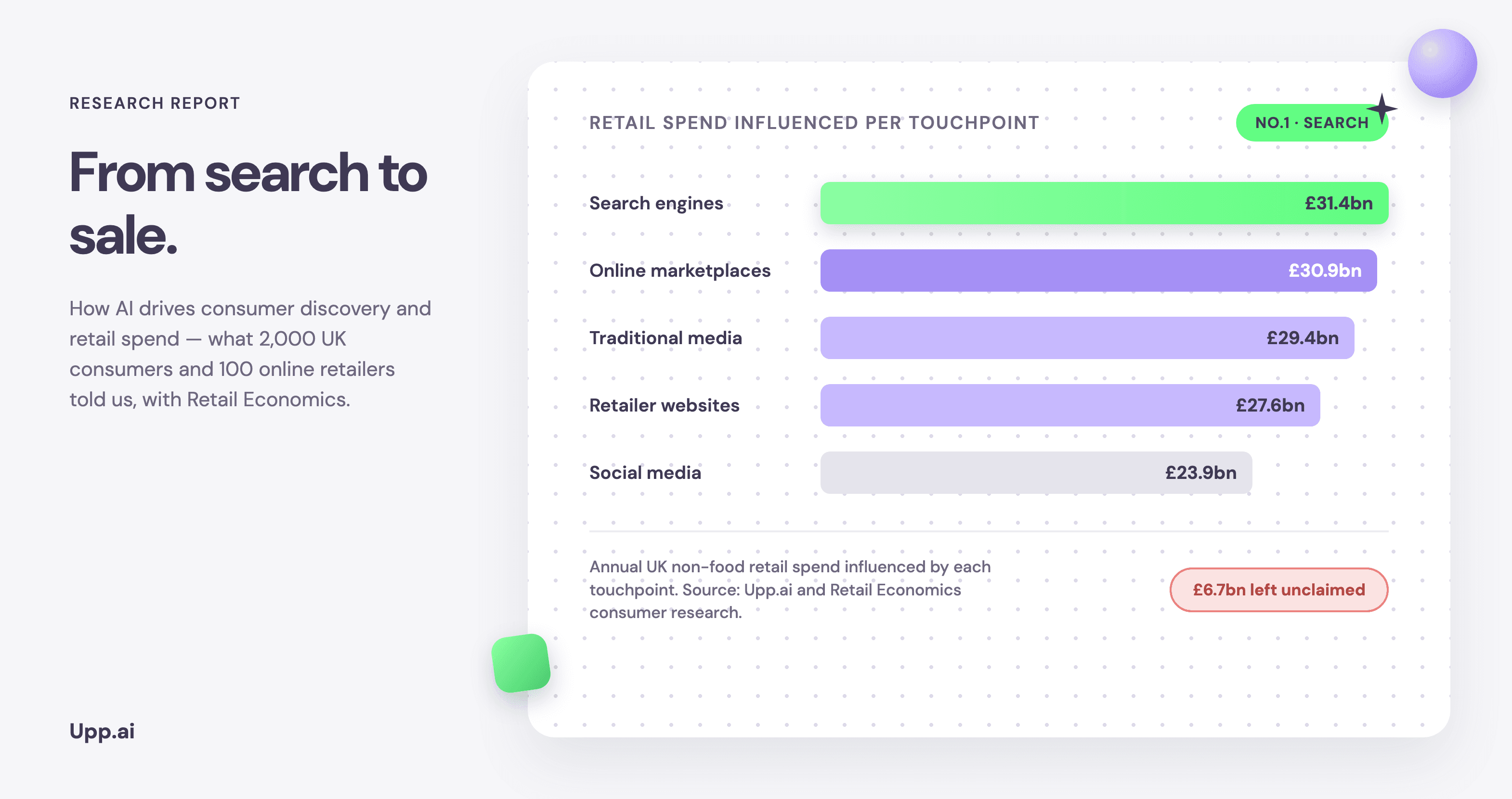
Where does a retail purchase actually begin? To find out, we partnered with Retail Economics and surveyed 2,000 UK consumers and 100 online retailers about how products get discovered, researched and bought. The answer, by a measurable margin: a search box. Search engines influence £31.4 billion of UK non-food retail spend — more than any other touchpoint, digital or physical.
That finding would be unremarkable if retailers acted on it. They largely do not. The same research shows retailers consistently rank their own websites and social media above search when judging what drives discovery — a perception gap the report values at £6.7 billion in annual sales. The spend is there; it is simply being claimed by whoever shows up when the shopper searches.
This article summarises the report's headline findings: where discovery actually happens, who the high-value search shoppers are, the four cohorts that make up pre-purchase search behaviour, and the role AI plays in converting search interest into sales. Fieldwork and figures throughout are from From Search to Sale, our research report with Retail Economics — download the full report (PDF) for every chart, the complete cohort profiles and the methodology.
Search is the biggest single influence on retail spend

UK consumers spend an average of 3 hours 41 minutes a day online outside work, and their discovery behaviour has followed. Digital channels now drive £130.7 billion of non-food retail discovery against £82.3 billion for physical retail and £42.3 billion for traditional media and advertising — meaning over half of purchases start at a digital touchpoint. Within that digital share, search engines lead every channel, physical or digital:
Annual UK non-food retail spend influenced per touchpoint
Search holds that position at the research stage too, not just at first discovery. Digital channels account for 48% of research occasions for new products, led again by search engines — and consumers trust them for pre-purchase research more than they trust retailers' own websites, because results are perceived as neutral. For expensive purchases, shoppers consult around three online sources on average, with search acting as the gateway to reviews, comparisons and retailer pages.
The £6.7 billion perception gap
We asked consumers and retailers the same question — which channels most influence discovery — and got two different answers. Consumers put search engines first. Retailers put the channels they control first, and pushed search down the list:
The report is clear about why this happens: search is complex and feels expensive, while owned channels promise control and quicker returns. But the shopper does not care which channel the retailer finds easier to manage. Underinvesting in search means being absent at the two moments that matter most — discovery and research — and the absence is invisible in your own reporting, because the sale that never started never shows up as a loss.
Retailers potentially overlook £6.7 billion in annual sales — £146 per shopper — by not prioritising online search.
The biggest spenders lean on search the hardest
The sharpest finding in the report cuts against instinct. Search influence is not strongest among digital-native 18 to 24s — it is strongest among 45 to 54s, who are also retail's most valuable shoppers. This group spends £6,500 a year on non-food retail, the most of any cohort, and search engines influence 16% of those purchases, the highest share of any age group.
The reason is the kind of shopping they do. With more disposable income and more complex decisions — family needs, home improvement, higher-ticket items — they run research-heavy missions: comparing products, warranties and prices to make a trusted purchase. Trust in search also rises with household income, which the report links to more frequent high-value purchases where neutral information matters. A search strategy aimed only at younger demographics misses the shoppers with the deepest baskets.
Four search cohorts, not one average shopper
Averages hide the texture. The report segments pre-purchase search behaviour into four cohorts, each needing different treatment in a search strategy:
- Convenience Seekers — 38% of shoppers, £12.4bn. The largest cohort. They prioritise routine and decide quickly, consulting two to three sources with search engines as the shortcut to what they need. Skew mobile. Win them with speed and availability.
- Informed Buyers — 33%, £10.8bn. Diligent researchers focused on trust, reliability and brand reputation. They consult the most sources pre-purchase — search, review sites, retailer websites, price comparison — and prefer desktop. Win them with proof: reviews, ratings and consistent information everywhere they check.
- Impulse Shoppers — 18%, £5.1bn. Spontaneous, promotion-led, minimal research — one source, if any — and primarily on smartphones. Win them with visibility at the exact moment of intent and friction-free paths to purchase.
- Digital Explorers — 11%, £3.1bn. Tech-savvy, trend-driven Gen Z and young shoppers who trust social media and marketplaces for browsing. The smallest spend today — and the clearest signal of where discovery habits head next.
Paid search works — when it respects the shopper

Retailers who do invest in paid search see it: 73% agree paid search ads lead to increased conversions, rising to 85% among large retailers with over £100 million in revenue. Consumers corroborate it — 71% of under-45s say paid search ads influence their purchasing decisions.
The caveat is earned trust. 45% of consumers treat paid ads with caution, preferring organic results, and poorly targeted ads actively erode confidence. Meanwhile 93% of retailers acknowledge they need to deliver more personalised content. The report's conclusion: relevance is the entire game. A paid search ad that matches intent, shows accurate price, stock and delivery, and lands at the right moment reads as help; the same ad mistargeted reads as noise.
What AI actually changes

The report closes on where the advantage now sits: not in buying more clicks, but in processing more signals. Four of its recommendations stand out for retail teams:
- Decide in real time. Consumer intent, search behaviour and competitor pricing shift constantly; AI that reads these signals live can adjust targeting and spend while the moment still exists, instead of in next week's review.
- Treat product data as the fuel. Pairing customer signals with enriched product data makes the whole range discoverable, not just hero lines — the same feed-quality discipline that decides Shopping visibility decides how well AI campaigns can sell your long tail.
- Optimise at SKU level, not account level. Budget flows to high-potential SKUs and away from waste only when the system sees performance product by product — the control layer that matters most inside Performance Max.
- Align campaigns with the business. Overstock, seasonal clearance and supplier funding are business imperatives an AI platform should understand and execute against — not afterthoughts bolted onto a bidding strategy.
One update worth adding since the report's fieldwork: discovery itself is shifting again, into AI assistants and answer engines. The behaviour the report documents — shoppers starting with a neutral search surface rather than a retailer's own property — is exactly the behaviour now moving into AI search surfaces and, increasingly, agent-led shopping. The retailers who closed the search perception gap are the ones positioned for that shift; the ones who didn't are about to find the gap widening.
The gap is an execution problem, not a knowledge problem
Most retail teams reading this already believe search matters. The gap persists because acting on it is operationally hard: thousands of SKUs, prices and stock positions moving daily, auctions resetting in real time, and a team that cannot manually match that tempo. That is not a failure of practitioners — it is a mismatch between the speed of the channel and the tools they have been given. Closing a £6.7 billion industry gap starts with closing the execution gap in one account: yours.
Frequently asked questions
What is the From Search to Sale report?
A research report by Upp.ai and Retail Economics on how UK consumers discover, research and buy retail products, and how retailer investment matches — or mismatches — that behaviour. It is based on a survey of 2,000 UK consumers and 100 online retailers, combined with Retail Economics' spend modelling across twelve physical and digital touchpoints.
How much UK retail spend do search engines influence?
£31.4 billion of annual non-food retail spend — more than online marketplaces (£30.9bn), traditional media (£29.4bn), retailer websites (£27.6bn), social media (£23.9bn) or any physical touchpoint. Digital channels together drive £130.7 billion of discovery, meaning over half of non-food purchases originate digitally.
What is the £6.7 billion perception gap?
Consumers rank search engines as the most influential discovery channel; retailers rank their own websites and social media higher and underrate search. The report estimates this mismatch costs retailers £6.7 billion in annual sales — about £146 per shopper — much of it captured by competitors who have optimised their search presence.
Which shoppers are most influenced by search?
Shoppers aged 45 to 54: search influences 16% of their non-food purchases, the highest of any age group, and they also spend the most — £6,500 a year on average. Their research-heavy, higher-ticket shopping makes neutral search results more valuable to them, and trust in search rises with household income.
Do paid search ads actually influence purchases?
Yes, with a condition. 71% of under-45s say paid search ads influence their purchasing decisions, and 73% of retailers agree paid search increases conversions — 85% among large retailers. But 45% of consumers treat paid ads with caution, so relevance decides the outcome: accurate, well-targeted ads convert, and mistargeted ones erode trust.
Source: From Search to Sale — how AI drives consumer discovery and retail spend, a research report by Upp.ai and Retail Economics, based on a survey of 2,000 UK consumers and 100 online retailers with spend modelling across twelve touchpoints; time-online figure from Ofcom's Online Nation research. Spend figures are modelled estimates for UK non-food retail and are a guide to relative channel influence, not a forecast for any individual account. Download the full report (PDF).
Move your paid media to AI
The report shows where search influence goes unclaimed. Rubin Deploy puts it to work — SKU-level execution across your channels, inside guardrails your team sets.
Keep reading
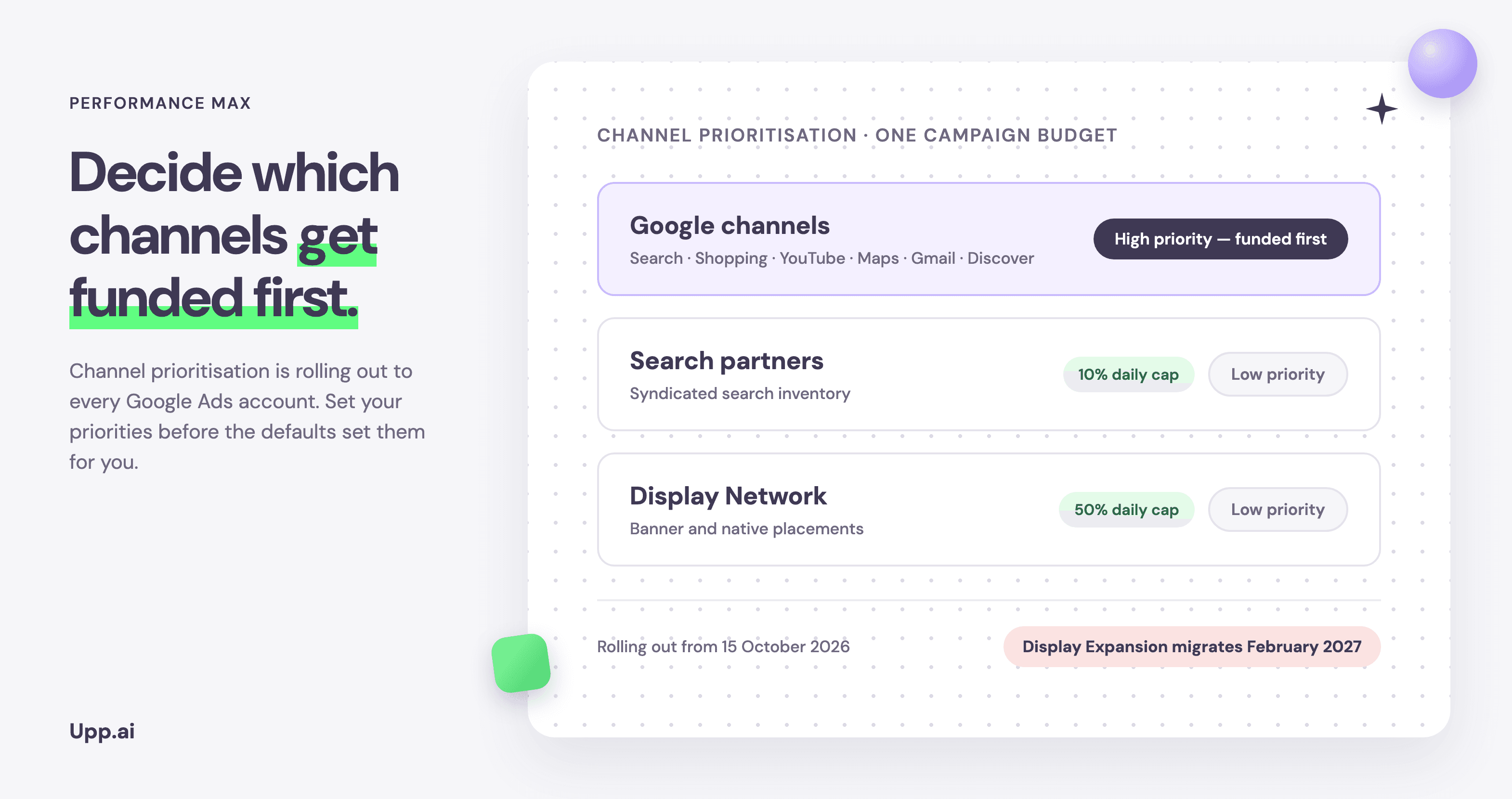
Performance Max channel prioritisation: the complete UK ecommerce guide
Google is rolling out channel prioritisation and budget allocation controls from 15 October. What UK retail teams can set inside PMax, what they still can't, and the February 2027 date to diary.
Upp.ai insights team
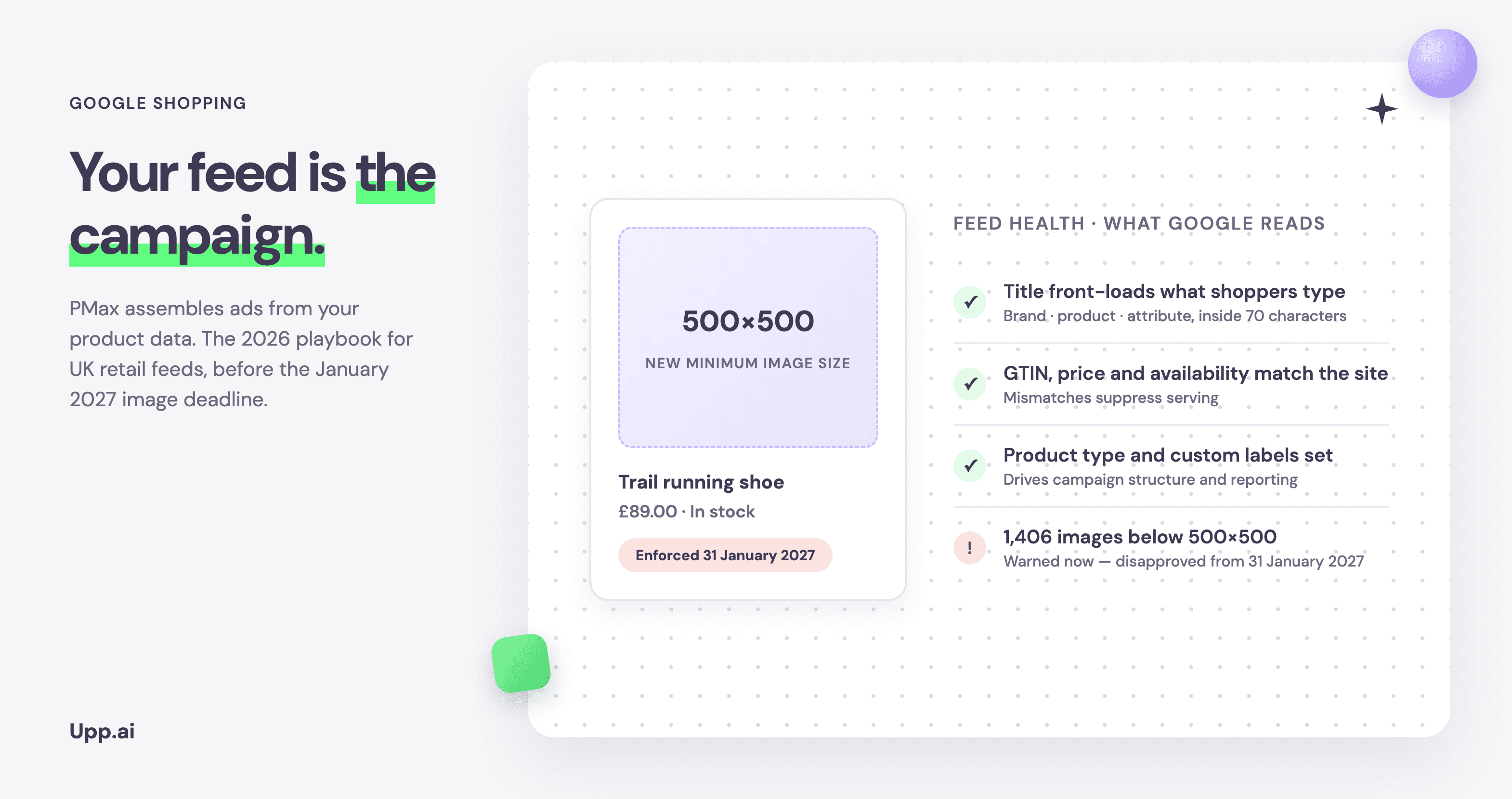
Google Shopping feed optimisation: the 2026 playbook for UK retail brands
PMax assembles your ads from your product data, so the feed decides which auctions you enter. A practical playbook for UK retail — and the 31 January 2027 image deadline to beat.
Upp.ai insights team
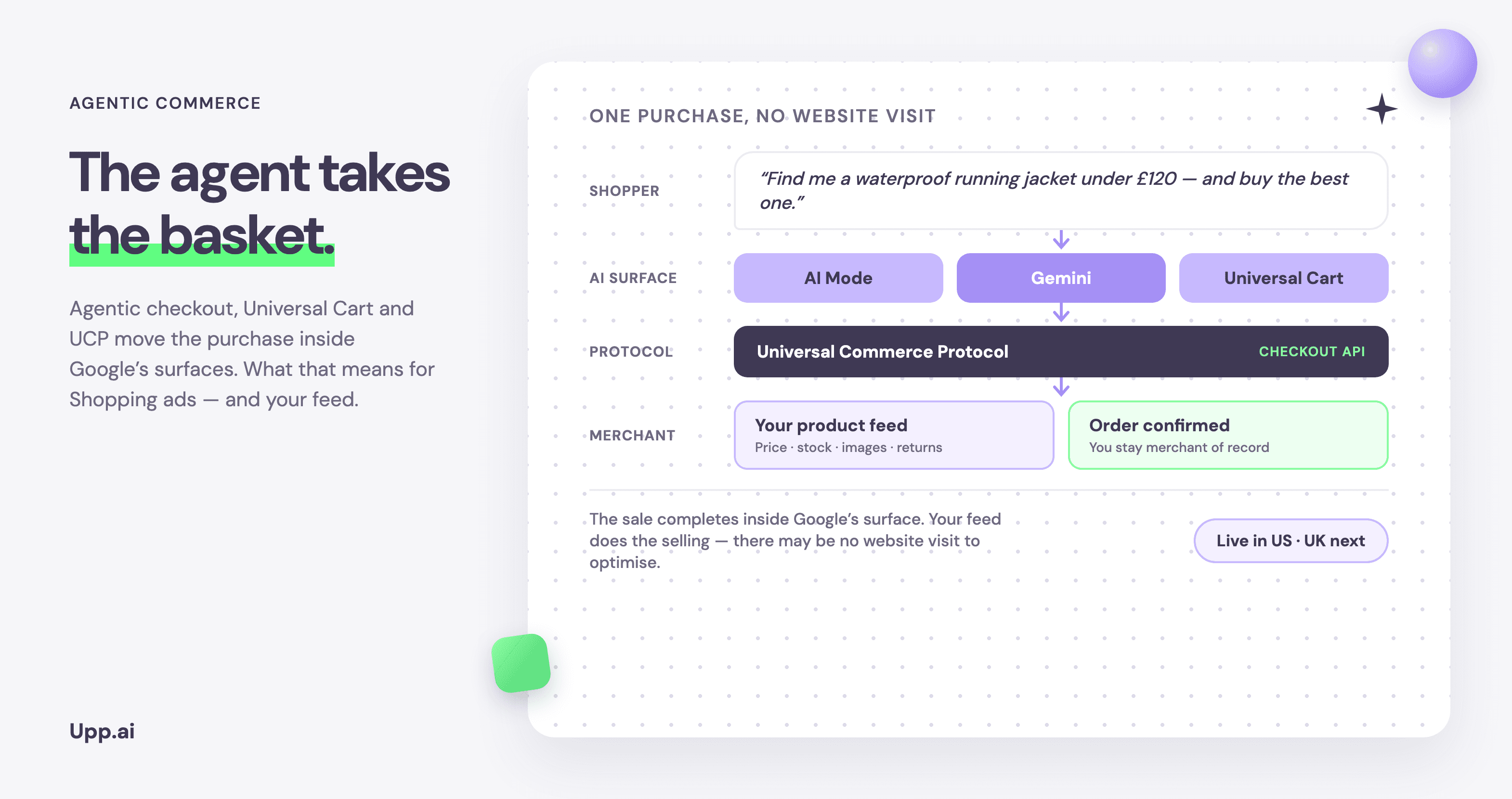
Agentic commerce: what agentic checkout, Universal Cart and UCP mean for Google Shopping
Google's agentic checkout and Universal Cart let shoppers buy without ever reaching your website. How the Universal Commerce Protocol works, what it does to Shopping ads and measurement, and the UK to-do list.
Upp.ai insights team